









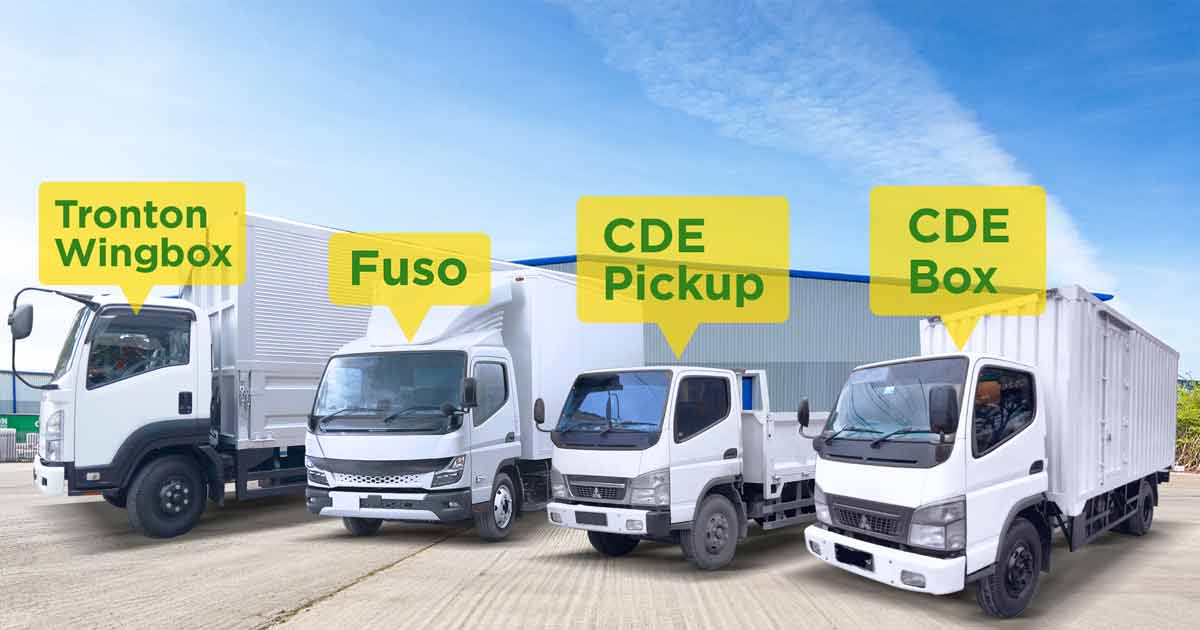
Fuso, tronton, and engkel truck rental prices in Indonesia for 2026 range from IDR 500,000 to IDR 6,500,000 per day, depending primarily on truck type, cargo capacity, rental duration, delivery distance, and region. Fuso, tronton, and engkel truck rental pricing in Indonesia follows a tiered logistics cost structure based on payload class. Engkel trucks carry up to 8 tons, fuso trucks handle 8 to 10 tons, and tronton trucks transport 18 to 25 tons. Each class carries its own daily and intercity rate range.
The price guide covers daily and monthly rental rates for engkel, Fuso, and tronton trucks, along with intercity pricing across Java, Sumatra, Kalimantan, Sulawesi, and Eastern Indonesia. Cargo weight, loading and unloading fees, add-on services, and peak-period surcharges can increase the total truck rental cost above the base rate.
- Engkel truck Colt Diesel Engkel (CDE) carries 2 to 3 tons of cargo capacity with daily rental rates of IDR 500,000 to IDR 1,200,000. Colt Diesel Engkel is used for retail goods distribution, SMEs logistics deliveries, and small household relocations on city and short-distance intercity routes.
- Engkel truck Colt Diesel Double (CDD) carries 5 to 8 tons of cargo capacity with daily rental rates of IDR 1,000,000 to IDR 1,500,000. Colt Diesel Double trucks are preferred for fast-moving consumer goods (FMCG) distribution, light manufacturing cargo, and intercity routes up to 300 kilometers.
- Fuso truck carries 8 to 10 tons of cargo capacity with daily rental rates of IDR 1,200,000 to IDR 3,000,000. Fuso trucks are used for factory goods, wholesale food cargo, and construction materials shipments.
- Tronton truck carries 18 to 25 tons of cargo capacity with daily rental rates of IDR 1,800,000 to IDR 6,500,000. Tronton trucks are used for industrial freight, project cargo deliveries, and interprovincial logistics distribution.
Each truck class above serves a distinct cargo weight range, which means the rate difference between engkel CDE and tronton reflects a capacity gap more than a pricing one. Shippers who select the wrong truck class either overpay for unused payload or book a vehicle that cannot legally carry the full load.
Price Disclaimer:
The fuso, tronton, and engkel truck rental prices on this article represent 2026 market rate ranges sourced from Indonesian logistics providers, freight platforms, the Indonesian Trucking Association (APTRINDO)’s published freight tariff, and licensed truck rental operators active on Java and outer-island routes. Actual rental costs vary based on the rental company, delivery region, cargo type, loading and unloading requirements, insurance coverage, driver overtime fees, and negotiated contract terms. Always request a formal written quotation from a truck rental provider before confirming any booking.
Last Updated 3 March 2026. The truck rental price list is reviewed and updated regularly to reflect current rental rent rates.
To review engkel truck rental rates by daily usage, city routes, and cargo weight class, read Engkel truck rental rates in Indonesia.
To compare fuso truck daily and intercity rental prices by cargo capacity and delivery distance, read fuso truck rental rates in Indonesia.
To explore tronton truck rental pricing by route distance, heavy cargo load, and peak-period surcharge, read tronton truck rental rates in Indonesia.
How Are Engkel, Fuso, and Tronton Truck Rental Costs Calculated Based on Distance and Usage?
Engkel, fuso, and tronton truck rental costs in Indonesia are calculated using two primary pricing frameworks, distance-based calculation charged per kilometer traveled, and usage-based calculation charged per day or per delivery trip. Truck rental cost calculations combine route distance in kilometers and cargo weight in tons. Other components such as fuel consumption ratios, loading and unloading duration, and the applicable per-kilometer tariff or daily rental rate are then calculated as additional cost.
- Distance-based truck rental pricing are calculated by multiplying the total route distance in kilometers by the truck’s applicable per-km tariff. Engkel box trucks carry a base per-km rate of IDR 3,000 to IDR 5,000 for standard cargo routes in Indonesia. Engkel truck rental pricing more affordable per kilometer than fuso and tronton truck rental pricing on the same delivery routes.
- Fuel cost are calculated by dividing the round-trip delivery distance by the truck’s fuel consumption ratio and multiplies by the diesel price per liter. A truck covering 800 km one-way at a fuel ratio of 1:3 (1 liter per 3 km) consumes approximately 267 liters of diesel. The fuel cost is added to the base rental tariff or adjusted under an agreed fuel adjustment clause.
- Flat daily rental rate billing covers an agreed number of operating hours. Engkel truck daily rates range from IDR 500,000 to IDR 1,200,000, Fuso truck daily rates from IDR 1,200,000 to IDR 3,000,000, and tronton truck daily rates from IDR 1,800,000 to IDR 6,500,000 across in-city and intercity routes in Indonesia for 2026.
- Per-trip rate pricing sets a fixed tariff for one full cargo delivery from origin to destination. In Indonesia, logistics providers commonly set this tariff based on truck type, route distance, and agreed terms. The rate typically includes driver commission, toll fees, parking, meal allowances, and sea crossing fees.
- Cargo weight adjustment directly affects the rental cost calculation when a per-kilogram (kg) or per-ton tariff model is applied. A tronton truck transporting a standard 20-ton load from Cilegon to Jakarta, for example, is priced at IDR 320 to IDR 400 per kg. Cargo weight that exceeds the truck’s legal payload limit triggers an overload surcharge added to the base rental rate.
- Diesel price volatility management is handled through one of three freight tariff adjustment methods. The methods are the Real Cost method, the Percentage Bahan Bakar Minyak (BBM) method, and the Price Table method. The Real Cost method adjusts the tariff by multiplying the price change per liter by the agreed total fuel liters consumed. The Percentage BBM method recalculates the fuel cost as an agreed percentage of the total tariff. The Price Table method uses pre-set rate brackets tied to specific diesel price ranges.
- Loading and unloading time counts toward contracted operating hours. Rental usage that exceeds those hours is charged as overtime billed per additional hour. Tronton truck overtime rates higher than fuso and engkel overtime rates on the same rental day.
Indonesian rental providers determine truck rental costs by combining a base tariff based on truck type, route, and distance, with extra charges for fuel, weight adjustments, driver fees, and services such as insurance and loading. Route distance is the primary price driver, while vehicle classification and cargo weight set the applicable per-kilometer rate.
What Factors Determine Distance-Based Truck Rental Pricing?
Distance-based truck rental pricing in Indonesia is determined by five measurable factors. The factors are delivery route distance, truck type, road complexity, cargo weight, and fuel ratio. Among these, route distance, truck type, and road complexity carry the greatest combined weight in the final per-kilometer cost calculation.
- Delivery route distance: Delivery route distance is the total one-way road distance in kilometers between the pickup and the destination location, measured along the actual road path traveled by the truck. Distance-based truck rental pricing in Indonesia applies tiered per-kilometer rates that decrease as total route distance increases. A short city route under 20 km on an Engkel CDE carries a per-kilometer rate of IDR 6,000 to IDR 8,000, while the same truck type on an intercity route exceeding 100 km drops to IDR 3,000 to IDR 5,000 per km, because the fixed operational cost is distributed across a greater number of kilometers on longer routes.
- Truck type and axle classification: Truck type and axle classification is the government-assigned vehicle category that determines the applicable base per-kilometer tariff and toll charge tier for each truck on Indonesian national roads. Each classification is defined by axle count and gross vehicle weight (GVW). Engkel CDE trucks have a single rear axle and a GVW of 5,000 kg. CDD trucks carry a dual rear axle with a GVW up to 8,500 kg. Fuso-class trucks operate at a GVW of 16,000 kg, and tronton trucks with three or more axles reach a GVW of up to 26,000 kg. This classification directly determines which toll Golongan applies at each gate and sets the per-km tariff floor that rental providers use as the starting point for all distance-based cost calculations.
- Road and route complexity: Road and route complexity describes how challenging the delivery path is for the truck, based on road surface condition, topography, traffic density, and road class. Routes through mountainous terrain, congested urban corridors, or degraded road surfaces increase fuel consumption per kilometer and extend operational hours for trucks, raising the total distance-based rental cost above the standard base tariff per kilometer.
- Declared cargo weight and legal payload limit: Declared cargo weight is the tonnage stated by the shipper at the point of booking. Legal payload limit is the maximum tonnage a truck is legally permitted to carry on Indonesian national roads under the Zero Over Dimensi Over Muatan (Zero ODOL) regulation, enforced by Indonesia’s Ministry of Transportation beginning in 2019 under Ministerial Regulation PM No. 60/2019. Cargo weight affects the rental cost when exceeds the truck’s standard payload limit. Exceeding the payload limits can trigger a per-kilogram overload surcharge added to the base tariff.
- Fuel consumption ratio: Fuel consumption ratios, representing kilometers traveled per liter, are used to calculate additional fuel costs based on APTRINDO benchmarks. Heavier trucks like trontons consume more fuel than engkels, resulting in higher surcharges under Real Cost BBM agreements.
Route distance is the primary factor controlled by shippers. Consolidating city runs into intercity routes lowers the per-kilometer rate by spreading fixed costs. However, toll and fuel rates are fixed by axle classification. For example, trontons always incur Golongan V fees on the Jakarta-Surabaya corridor. Since axle class determines fuel and toll tiers, truck selection is the critical cost decision that sets the pricing floor and baseline before route planning begins.
Does the Truck Type Affect per-Kilometer Pricing?
Yes, truck type directly affects per-kilometer pricing for truck rentals in Indonesia. Tronton trucks carry the highest per-kilometer rate, Fuso trucks are priced at a middle tier, and engkel trucks carry the lowest per-kilometer rate on equivalent intercity delivery routes.
For Jakarta-Bandung corridor at approximately 148 kilometers, an engkel CDE carrying 2 to 3 tons costs IDR 835,000 per trip, an engkel CDD carrying 5 to 8 tons costs IDR 1,300,000, a Fuso truck carrying 8 to 10 tons costs IDR 2,250,000, and a tronton carrying 18 to 25 tons costs IDR 3,050,000. The Jakarta-Surabaya corridor at approximately 800 kilometers follows the same stepped structure. Engkel CDE costs IDR 2,500,000, engkel CDD costs IDR 3,500,000, Fuso costs IDR 6,200,000, and tronton costs IDR 8,010,000 on that same route. Derived per-kilometer rates show the same tiered pattern across both corridors. Engkel CDE produces IDR 3,000 to IDR 5,000 per kilometer, engkel CDD produces IDR 5,000 to IDR 9,000 per kilometer, Fuso produces IDR 7,500 to IDR 14,000 per kilometer, and tronton produces IDR 10,000 to IDR 19,000 per kilometer on equivalent intercity routes.
Three cost components explain the rate gap. A tronton burns more diesel per kilometer than an engkel, and that fuel cost is built directly into the tariff rather than billed separately. Toll fees push the gap wider. A tronton classified as Golongan V pays IDR 40,000 to IDR 70,000 per gate section. An engkel classified as Golongan IV pays IDR 30,000 to IDR 50,000 per gate section. The difference compounds across every toll section on a long-haul corridor. Tronton drivers on intercity routes command higher commission rates and require mandatory rest stop allowances that engkel drivers on the same route don’t. That overhead is fixed per kilometer and doesn’t shrink regardless of how efficiently the route is planned.
Can Additional Stops Change the Total Rental Cost?
Yes, additional stops can increase the total truck rental cost. Each additional stop extends total route distance, consumes contracted operating time, and triggers per-stop service fees on top of the tariff. For usage-based daily rentals, additional stops consume contracted operating hours. When total delivery time exceeds the agreed window, the truck rental provider bills overtime charges at IDR 50,000 to IDR 200,000 per additional hour, depending on truck type.
For example, a single-drop and a 4-drop multi-stop route will have a different final rental rate. Both routes share the same base daily rate of IDR 900,000 for a 10-hour rental window. On the single-drop route, no additional charges apply , so the total rental cost stays at IDR 900,000. The 4-drop multi-stop route on the same rental day produces three additional cost items. The three extra stops add 24 kilometers of detour distance at 8 kilometers per stop, billed at IDR 5,000 per kilometer for a total of IDR 120,000. Each of the three extra stops carries a per-stop service fee of IDR 90,000, adding IDR 270,000 to the base rate. No overtime applies in this example because the total delivery time stays within the 10-hour contracted window. The total rental cost on the 4-drop route reaches IDR 1,290,000 which is IDR 390,000 above the single-drop cost on the same rental day.
Four variables determine the total additional cost from multi-stop truck deliveries. They are the number of extra unloading points added to the route, the road distance between each additional stop, the unloading time required per stop, and whether the accumulated stop time pushes total daily usage beyond the contracted operating hours.
Tip: Planning multi-stop delivery routes efficiently prevents overtime charges and keeps the total rental cost within the base daily rate
|
How is Truck Usage Measured for Rentals Pricing?
Truck usage for rental pricing is measured by recording three primary metrics. The metrics are kilometers driven via odometer or GPS, hours on hire via rental timer or driver logbook, and cargo weight via cargo manifest or weighbridge certificate. Distance applies to per-trip and per-kilometer contracts. On-hire time applies to daily and full-day rentals. Cargo weight applies to weight-based truck agreements and overloading penalty clauses on inter-provincial routes governed by Indonesia’s Ministry of Transportation road load regulations.
The mechanical odometer captures total kilometers traveled from departure to final return. Rental operators will record start and end readings at dispatch and arrival to calculate billable distance on per-trip contracts. Digital logistics platforms use GPS distance log to record real-time route distance, on-road time, stop durations, and return mileage, producing a verifiable timestamped trip log that replaces or audits manual odometer records on high-value cargo routes.
GPS timestamps are legally admissible as a billing audit document under Indonesian logistics platform terms of service. Shippers handling electronics, pharmaceutical, or perishable cargo should request GPS-verified trip reports as a standard invoice attachment. For operators without GPS systems, drivers maintain a written logbook recording departure time, arrival time, odometer readings at each stop, fuel consumption, and cargo manifest details, making the logbook the primary billing document for conventional truck rental operators.
| Usage Metric | What It Records | Measurement Tool | Billing Application |
| Distance (kilometers) | Total kilometers driven from pickup to final delivery point | Odometer; GPS distance log | Per-kilometer rate multiplied by total kilometer driven; minimum kilometer charge applies on short hauls |
| Time (hours on hire) | Total hours the truck and driver are in service, including transit, waiting, loading, and unloading | Rental timer; driver logbook; GPS timestamps | Daily rental window (8 to 10 hours); overtime rate charged per hour beyond the agreed limit |
| Cargo weight (tons) | Total weight of freight loaded onto the truck bed | Cargo manifest; weighbridge certificate at origin | Weight surcharge on tronton contracts above agreed payload; overloading penalties under Ministerial Regulation PM No. 60/2019 |
Kilometer-based billing is highly predictable due to verifiable odometer and GPS records. Conversely, loading and waiting times make on-hire time the most variable metric, though shippers can mitigate this through better site scheduling. Cargo weight primarily affects weight-based contracts and legal compliance under PM No. 60/2019, which regulates axle loads and penalties for overloading on inter-provincial routes.
The billable period spans from dispatch until the truck returns to the depot, making total on-hire hours longer than transit time. Excluding pre-trip and post-delivery legs leads to undercounting costs. Daily rates often differ from final invoices on intercity contracts due to these additional phases.
Is Loading and Unloading Time Included in Usage Fees?
Yes, loading and unloading time is included in usage fees for truck rentals in Indonesia. The loading and unloading time reduces the remaining hours inside the daily rental window and triggers overtime fees when cumulative loading delays push the total trip duration past the agreed rental limit. Loading labor is a separate charge from loading time. The driver performs loading and unloading only when this is explicitly included in the service tier, while the rental window runs continuously from dispatch to return regardless of whether the driver assists with handling at all. When loading delays extend the trip past the rental window, overtime charges apply to every truck class. All types of trucks accrue overtime at the provider’s published rate, independent of who performs the physical labor.
Each provider sets its own loading labor inclusion, free waiting period, and overtime billing terms. Deliveree covers the widest vehicle range across both standard intracity and Full Day service tiers. Covered vehicle types include car, van, pickup, small box, CDE, CDD, CDD Long, Fuso, and tronton. On standard intracity bookings, the driver performs loading and unloading up to 15 meters from the vehicle free, with 1 hour of free waiting per location on small vehicles and 6 hours free per booking on CDD and CDD Long services, overtime applies after the free window at a rate depends by vehicle type. Full Day bookings exclude loading and unloading labor from the base price, with the option as an extra service for an additional fee.
Other providers, Kargo Technologies treats loading and unloading as the shipper’s and consignee’s responsibility across all vehicle types. Kargo Technologies grants 1 hour of free waiting per location on standard FTL bookings. After the free window expires, a Detention Charge of IDR 80,000 to IDR 250,000 per hour applies, depending on truck size. Other examples, Klik Logistics and ALD Logistics are a conventional logistics operator where the driver handles vehicle operation only. Loading and unloading at both origin and destination are the shipper’s and consignee’s responsibility. Both Klik Logistics and ALD Logistics governs the waiting period and all overtime terms through an agreement on a contract basis.
Deliveree’s standard intracity service is the only provider among the four that includes loading and unloading labor in the base rental fee. Kargo Technologies, ALD Logistik, and Klik Logistics treat it as the shipper’s operational responsibility at both origin and destination. Shippers using those three providers must budget separately for loading labor and monitor dwell time against the free waiting window to avoid per-hour detention charges.
What are the Rental Rates Based on Different Truck Types?
Engkel, fuso, and tronton truck rental rates in Indonesia for 2026 are classified into four tiers based on cargo capacity. The tiers are engkel CDE at IDR 500,000 to IDR 1,200,000 per day, engkel CDD at IDR 1,000,000 to IDR 1,500,000 per day, Fuso at IDR 1,200,000 to IDR 3,000,000 per day, and tronton at IDR 1,800,000 to IDR 6,500,000 per day. Rental rates for each truck type include a daily rental rate and a per-kilometer rate. Both rates increase proportionally with cargo capacity class because heavier truck classes consume more fuel, carry a higher toll axle classification, and require higher driver operational costs.
| Truck Type | Daily Rate (IDR) | per KM Rate (IDR) | Max Cargo | Notes |
| Engkel CDE | 500,000 – 1,200,000 | 3,000 – 5,000 | 3 tons | Most affordable class. Suited for urban retail, UMKM logistics, and intra-city relocations. |
| Engkel CDD | 1,000,000 – 1,500,000 | 5,000 – 9,000 | 8 tons | Standard for FMCG and retail supply chains across Java and Bali. Good for intercity up to 300km. |
| Fuso | 1,200,000 – 3,000,000 | 7,500 – 14,000 | 10 tons | Medium-duty for factory goods and construction. Note the Golongan IV-V toll rates. |
| Tronton | 1,800,000 – 6,500,000 | 10,000 – 19,000 | 25 tons | Heavy-duty for industrial freight and long-haul project cargo. Golongan V toll classification applies. |
Truck class selection is a use-case decision as much as a pricing decision. Engkel CDE trucks serve retail distribution and intra-city UMKM logistics, fuso trucks handle intercity factory and construction freight under Golongan IV to V toll classification, and tronton trucks carry heavy industrial loads now subject to the Zero ODOL overload regulation enforced from 2019 under PM No. 60/2019, each with a cost structure that reflects those operational demands.
How Much does it Cost to Rent an Engkel Truck in 2026?
Renting an engkel truck in Indonesia in 2026 costs between IDR 500,000 and IDR 1,500,000 per day, depending on the sub-type. Engkel CDE daily rates range from IDR 500,000 to IDR 1,200,000, while engkel CDD daily rates range from IDR 1,000,000 to IDR 1,500,000. Engkel truck rental costs on a per-kilometer basis range from IDR 3,000 to IDR 5,000 per kilometer for engkel CDE and from IDR 5,000 to IDR 9,000 per kilometer for engkel CDD on standard intercity routes. Shorter routes under 50 kilometers carry higher per-kilometer charges than long-distance routes because fixed driver and fuel costs are distributed across fewer kilometers.
Body configuration doesn’t change the rate within either sub-type. Both the open flatbed CDE and the box CDE carry a daily rate of IDR 500,000 and a per-kilometer rate of IDR 3,000 to IDR 5,000, with a maximum cargo capacity of 3,000 kilograms. Both the open flatbed CDD and the box CDD carry a daily rate of IDR 1,000,000 and a per-kilometer rate of IDR 5,000 to IDR 9,000, with a maximum cargo capacity of 8,000 kilograms. Body type on engkel trucks is a cargo handling consideration, not a pricing one.
Six factors raise engkel truck rental costs above the base rate. First, the delivery location and city tier affect rates because Jakarta, Surabaya, and Bandung carry higher base prices than smaller Java cities. Second, engkel CDE rentals on intercity routes above 400 kilometers shift from a daily rate to a per-trip tariff of IDR 3,250,000 to IDR 4,500,000. Long-haul deliveries exceed the standard 8 to 10 hour rental window, triggering the per-trip structure rather than the daily rate. Third, overtime on shorter daily rentals adds IDR 50,000 to IDR 100,000 per additional hour beyond the contracted limit. Fourth, loading and unloading assistance beyond the standard 15-meter driver range adds IDR 90,000 to IDR 200,000 per session on the contracts. Fifth, fuel surcharges add IDR 150,000 to IDR 250,000 per trip on routes of 50 to 150 kilometers depending on current diesel prices. Sixth, toll road fees accumulate at IDR 30,000 to IDR 50,000 per section on intercity routes.
In general market price, engkel CDE delivery from Bandung to Jakarta is priced at IDR 835,000 per trip, or IDR 5,641 per kilometer. On Deliveree, the same route is priced at IDR 756,000 to IDR 1,035,000 depending on direction, reflecting backhaul pricing, where the return leg is discounted to avoid an empty trip. Toll road fees of IDR 80,000 to IDR 120,000 across Cipularang and inner Jakarta toll gates, optional loading assistance of IDR 0 to IDR 150,000, and a fuel surcharge of up to IDR 250,000 under fuel-excluded contracts are then added to the base trip cost. The all-in total reaches IDR 915,000 to IDR 1,365,000, bringing the total to 6 to 22 percent above the base tariff. The Bandung to Jakarta breakdown shows fuel policy and toll inclusion are the two factors with the greatest impact on the final engkel rental cost.
What is the Rental Price Range for Fuso Trucks in 2026?
The Fuso truck rental price range in Indonesia in 2026 spans IDR 1,200,000 to IDR 3,000,000 per day for in-city and intercity daily contracts. Per-trip rates on intercity routes from Jakarta range from IDR 1,500,000 to IDR 6,848,000, with a per-kilometer rate of IDR 7,500 to IDR 14,000 depending on route distance, truck model, and origin region. For long-distance intercity shipments, fuso truck pricing shifts from a daily rate to a per-trip tariff. Routes from Jakarta range from IDR 1,500,000 for a short 50-kilometer run to Bogor to IDR 6,848,000 for an 800-kilometer run to Surabaya.
The effective per-kilometer rate decreases as route distance increases because the base vehicle rate and driver cost are distributed across a larger distance on longer routes. The Jakarta to Bogor route at 50 kilometers produces an effective rate of around IDR 30,000 per kilometer, while a Jakarta to Surabaya run at 800 kilometers produces IDR 8,560 per kilometer. Intercity daily rates span a narrower band at IDR 2,000,000 to IDR 2,800,000, compared with the wider in-city range of IDR 1,200,000 to IDR 3,000,000. Intercity trips follow fixed route tariffs, while in-city rates fluctuate by truck type, fleet supply, and platform. Cross-island routes to destinations such as Palembang and Medan are not comparable on a per-kilometer basis because the sea crossing introduces a fixed ferry cost component, making cross-island fuso bookings a flat negotiated figure.
Five factors influence the Fuso rent pricings. Truck model and body type set the cost baseline. Fuso box trucks cost more than open flatbeds on the same route because the enclosed body adds weight, reduces available payload capacity, and increases fuel use. Origin region and fleet availability shift the base rate by geography. Rentals departing from Sumatra, Kalimantan, Sulawesi, and Eastern Indonesia run 25 to 40 percent above the Java range because fleets are less dense and routes are longer in those regions. In-city rentals under 50 kilometers fall toward IDR 1,200,000 to IDR 1,800,000, while intercity Java routes from 50 to 800 kilometers push the rate toward IDR 2,000,000 to IDR 2,800,000. Contract duration and cargo weight complete the pricing range. Weekly and monthly contracts reduce the effective daily rate compared with single-day bookings, while heavier loads increase total rental cost through higher fuel use and full-load charges.
How Much does it Cost to Rent a Tronton Truck in 2026?
Renting a tronton truck in Indonesia in 2026 costs between IDR 1,800,000 and IDR 2,500,000 per day on usage-based daily contracts. On distance-based intercity contracts across Java routes, tronton truck rental costs between IDR 3,000,000 and IDR 8,900,000 per trip. Tronton truck rental costs on a per-kilometer rate basis range from IDR 10,000 to IDR 19,000 per kilometer depending on route distance and corridor. Shorter routes produce a higher effective per-kilometer rate because the Golongan V toll classification, driver operational costs, and fixed fuel overhead are distributed across fewer kilometers than on long-haul inter-provincial routes.
Tronton truck daily rental rates in Indonesia are divided into two primary contract types. In-city routes carry a daily rate of IDR 1,800,000 to IDR 2,500,000 on an 8 to 10-hour operating window. Intercity routes on Java corridors carry a daily rate of IDR 3,000,000 to IDR 4,000,000 on a 10 to 12-hour operating window. The national market range extends from IDR 1,800,000 to IDR 5,000,000 per day, with the operating window varying by contract terms. The IDR 1,200,000 daily rate gap between in-city and intercity tronton route reflects the additional driver cost components that intercity routes carry. The three components are Golongan V toll accumulation across multiple gate sections, mandatory rest stop allowances on routes above 400 kilometers, and the higher fuel consumption rate at highway speeds. The national range market ceiling of IDR 5,000,000 extends above the Java intercity maximum of IDR 4,000,000 because outer-island from Java has lower fleet density and longer inter-hub distances.
Deliveree 2026 tronton rates show an inverse relationship between distance and per-kilometer costs. Jakarta to Bandung route with 148 km distance, costs IDR 3,050,000 or IDR 18,485 per km, while Jakarta to Surabaya with 800 km distance, costs IDR 8,010,000 or IDR 10,013 per km. Bandung to Surabaya with 700 km distance has a rent rate of IDR 6,150,000, and Surabaya to Jakarta with 800 km distance, offers the lowest rate at IDR 6,875 per km. Tolls on the Jakarta-Surabaya route add IDR 700,000 to IDR 1,200,000, making toll inclusion a critical contract term.
What are the Key Differences in Rentals Rates Among Engkel, Fuso, and Tronton Trucks?
The key differences in rental rates among engkel, fuso, and tronton trucks in 2026 are daily rate range, per-kilometer rate tier, cargo capacity class, and toll charge classification. Engkel CDE sits at the lowest tier at IDR 500,000 per day and IDR 3,000 per kilometer for 2 to 3 tons. Fuso occupies the middle tier at IDR 1,200,000 to IDR 3,000,000 per day and IDR 7,500 to IDR 14,000 per kilometer for 8 to 10 tons. Tronton holds the highest tier at IDR 1,800,000 to IDR 6,500,000 per day and IDR 10,000 to IDR 19,000 per kilometer for up to 25 tons.
| Truck Type | Daily Rate Range | Per-KM Rate | Cargo Capacity | Notes |
| Engkel CDE (2-axle) | IDR 500k – 1.2jt | IDR 3k – 5k | 2 – 3 tons | Lowest rate class. Ideal for UMKM retail and short-haul city routes; toll class Golongan IV. |
| Engkel CDD (2-axle) | IDR 1jt – 1.5jt | IDR 5k – 9k | 5 – 8 tons | Higher GVW than CDE. Preferred for mid-volume intercity distribution up to 300km; toll class Golongan IV. |
| Fuso (3-axle) | IDR 1.2jt – 3jt | IDR 7.5k – 14k | 8 – 10 tons | Middle-tier. Used for factory goods and construction materials on cross-province routes; toll class Golongan IV. |
| Tronton (multi-axle) | IDR 1.8jt – 6.5jt | IDR 10k – 19k | 18 – 25 tons | Highest rate class. Used for heavy industrial and long-distance cargo; toll class Golongan V. |
Three pricing differences separate engkel, fuso, and tronton truck rental costs in Indonesia. The daily rate spans from IDR 500,000 at the engkel CDE minimum to IDR 5,000,000 at the tronton maximum, a difference of more than eight times between the lightest and heaviest truck class. The per-kilometer rate runs from IDR 3,000 per kilometer on engkel CDE to IDR 19,000 per kilometer on tronton, a difference of more than six times on identical intercity routes. That gap narrows on long-distance corridors above 700 kilometers, where tronton per-kilometer rates fall toward IDR 10,000 to IDR 10,500 per kilometer and engkel rates fall toward IDR 3,200 to IDR 4,500 per kilometer. Cost efficiency per ton reverses the daily rate ranking entirely. Tronton truck rental costs IDR 60,000 to IDR 167,000 per ton per day, compared with engkel CDE’s IDR 200,000 to IDR 500,000 per ton per day. Shippers with cargo above 8 tons pay less per ton on a single fuso or tronton than on two or three engkel trucks covering the same route.
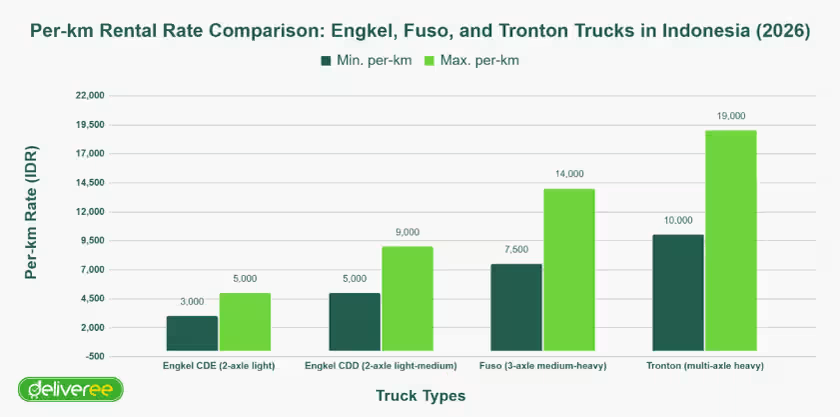
The per-kilometer rate chart confirms that per-kilometer costs scale consistently with truck class across all four vehicle types. Route distance is a key cost multiplier when selecting the right truck type for an intercity shipment.
Does Truck Capacity Directly Affect the Rental Price?
Yes, truck capacity directly sets the rental rate tier. Each step up from engkel CDE to engkel CDD to Fuso to tronton raises the base daily rate, running from IDR 500,000 at the engkel CDE floor to IDR 5,000,000 at the tronton ceiling. On standard Java corridor contracts, tronton rates cluster more tightly at IDR 2,500,000 to IDR 3,500,000 per day. The trade-off is real though. A higher capacity truck costs more per day but less per kilogram of freight actually moved.
The relationship between capacity and price operates across two dimensions. The first dimension is the daily rate. Each step up in payload class carries a higher base rental rate. Larger trucks require higher fuel consumption, higher-grade drivers, more robust insurance coverage, and greater maintenance overhead per operating day. The second dimension is the per-kilometer rate. Heavier trucks like fuso and tronton command a higher nominal per-kilometer rate than engkel CDE on identical corridors. But because they distribute that cost across a much larger cargo volume, the effective freight cost per ton-kilometer decreases at higher capacity.
Cost per 100 kilograms of payload capacity falls consistently as truck class increases. Engkel CDE carries a maximum of 3,000 kilograms at a daily rate of IDR 500,000 to IDR 1,200,000, producing an estimated rate of IDR 360,000 to IDR 480,000 per 100 kilograms of capacity. Engkel CDD carries 8,000 kilograms at IDR 1,000,000 to IDR 1,500,000 per day, dropping the rate to IDR 227,000 to IDR 340,000 per 100 kilograms. Fuso box and fuso standard both carry 10,000 kilograms at IDR 1,200,000 to IDR 3,000,000 per day, producing an estimated rate of IDR 125,000 to IDR 188,000 per 100 kilograms across both body configurations. Tronton carries 25,000 kilograms at IDR 1,800,000 to IDR 5,000,000 per day, with the lowest estimated rate of IDR 75,000 to IDR 175,000 per 100 kilograms, making it the most cost-efficient truck class per unit of cargo capacity when loaded.
A tronton costs more than five times as much per day as an engkel CDE, but its cost per 100 kilograms of payload capacity is nearly five times lower. A shipper filling a tronton to full capacity pays far less per unit of freight than a shipper using multiple engkel trips to move the same total load. Under-loading a large truck erases this efficiency advantage entirely. A tronton carrying 5 tons of a possible 25-ton capacity at IDR 6,500,000 per day costs more per kilogram than a fully loaded fuso box at IDR 2,000,000 per day carrying 10 tons.
Tip: Always match your cargo weight to the truck class before comparing rental prices:
Renting a truck larger than your cargo requires wastes the fixed daily rate on empty space. Renting a truck too small forces a second trip, doubling the total rental cost. |
What are the Rental Rates for Fuso Trucks in Indonesia?
Fuso truck rental rates in Indonesia in 2026 range from IDR 1,200,000 per day for in-city Java contracts to IDR 6,500,000 per day in Eastern Indonesia. Outer-island markets including Sumatra, Kalimantan, Sulawesi, and Eastern Indonesia carry regional premiums above the Java standard due to lower fleet density, longer intercity distances, and higher operating costs. Intercity daily rates include a 10 to 12 hour operating window. In-city daily rates include an 8 to 10 hour operating window. Toll fees, loading and unloading labor, and overtime charges are billed separately.
| Model | Max Cargo | Daily Rate (IDR) | Rate / KM (IDR) | Region |
| Fuso Box | 8 – 10 tons | 1.2m – 2.5m | 9,000 – 14,000 | Java (In-city) |
| Fuso Bak | 8 – 10 tons | 1.4m – 2.2m | 7,500 – 12,500 | Java (Intercity) |
| Fuso Box | 8 – 10 tons | 2.5m – 4.0m | 11,000 – 18,000 | Sumatra |
| Fuso Box | 8 – 10 tons | 2.8m – 4.5m | 12,000 – 20,000 | Kalimantan |
| Fuso Box | 8 – 10 tons | 3.0m – 5.0m | 13,000 – 22,000 | Sulawesi |
| Fuso Box | 8 – 10 tons | 3.5m – 6.5m | 15,000 – 26,000 | East Indonesia |
Regional price variation across fuso truck rental rates is driven by three measurable differences between Java and outer island provinces. Kalimantan and Eastern Indonesia have fewer active logistics platforms and a smaller pool of available fuso fleets per province than Java. The condition produces a daily rate premium of 40 to 80 percent above the Java baseline. Fuel distribution costs outside Java are higher because diesel prices in outer island provinces are not uniformly subsidized at the Java pump price, increasing the fuel cost component built into per-kilometer rental rates in Sumatra, Kalimantan, and Eastern Indonesia. Inter-city road distances between logistics hubs are longer on outer islands. A fuso truck covering the Sumatra or Kalimantan equivalent of the Jabodetabek to Semarang route travels on a road network with fewer toll sections, lower average road speed, and greater per-kilometer driver operational cost than on Java’s Trans-Java Toll Road corridor.
What is the Average Daily Rental Rate for Fuso Trucks in 2026?
The average daily rental rate for Fuso trucks in Indonesia in 2026 ranges from IDR 1,200,000 to IDR 2,500,000 per day on Java routes. Nationally, the full market range spans IDR 1,200,000 for Java in-city contracts to IDR 6,500,000 for Eastern Indonesia intercity contracts, with regional premiums accounting for the difference. The fuso daily rate range sits above the engkel daily rate floor and below the tronton daily rate ceiling, confirming fuso’s position as the middle pricing tier across all truck classes.
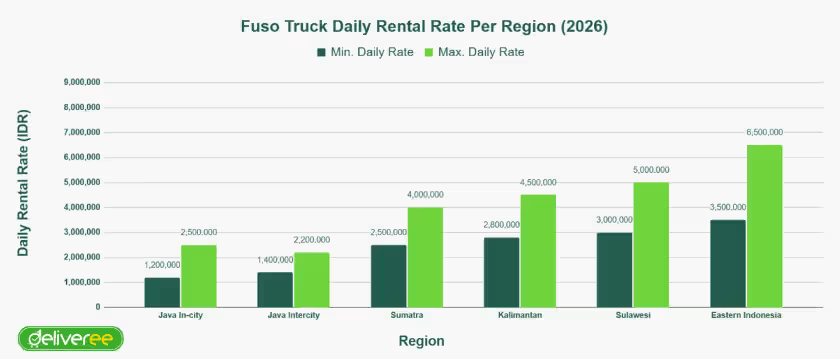
Five factors determine where a fuso truck rental falls within the IDR 1,200,000 to IDR 6,500,000 daily rate range. Region and island zone carry the largest single impact. A fuso box model booked in Jayapura costs 2.4 to 3.3 times more per day than an identical booking in Jakarta. Java rates run IDR 1,200,000 to IDR 2,500,000 per day, while Eastern Indonesia runs IDR 3,500,000 to IDR 6,500,000. Route type adds a 40 to 70 percent premium on top of the regional base. In-city routes under 50 kilometers fall between IDR 1,200,000 and IDR 1,800,000 per day, while intercity routes above 50 kilometers push the daily rate to IDR 2,000,000 to IDR 3,000,000 for the same model. Fuso model and body type shift the rate by IDR 200,000 to IDR 800,000 per model tier step on the same route and region, with box trucks costing more than open flatbeds due to added body weight and higher fuel use. Season and contract duration complete the range. Peak demand periods such as Eid al-Fitr, Christmas to New Year, and regional harvest cycles push daily rates 10 to 25 percent above standard benchmarks. Single-day bookings carry the full market rate. Weekly contracts reduce the effective daily rate by approximately 10 to 15 percent. Monthly contracts negotiated at 20 to 25 guaranteed rental days per month reduce the effective daily rate by a further 10 to 15 percent through utilization-based discounts.
What Are the Rentals Rates for Tronton Trucks in Indonesia?
Tronton truck rental rates in Indonesia start at IDR 1,800,000 to IDR 3,500,000 per day for Java open flatbed contracts. Rates reach IDR 6,500,000 per day in Eastern Indonesia, where limited fleet supply, ferry-linked repositioning, and higher fuel distribution costs drive up the base daily rate.
| Model | Daily Rate (IDR) | Rate / KM (IDR) | Max Cargo | Region / Island |
| Tronton Flatbed | 1.8m – 3.5m | 7,000 – 12,000 | 18 – 25 tons | Java (Jabodetabek, SBY) |
| Tronton Wing Box | 3.0m – 6.5m | 9,000 – 15,000 | 18 – 25 tons | Java (JKT, SBY) |
| Tronton Bak | 3.0m – 4.0m | 10,000 – 16,000 | 18 – 25 tons | Sumatra (Medan, PLM) |
| Tronton Bak | 3.5m – 5.0m | 12,000 – 18,000 | 18 – 25 tons | Kalimantan (BPN, BNJ) |
| Tronton Bak | 4.0m – 6.5m | 13,000 – 20,000 | 18 – 25 tons | Sulawesi & East IDN |
Tronton rental rates across Indonesia follow three broad regional patterns. Java has the lowest daily rates because road infrastructure is better, fleet supply is larger, and provider competition is stronger, keeping prices within the IDR 1,800,000 to IDR 3,500,000 range. Kalimantan rates are higher than Sumatra rates because of tougher road conditions and stronger freight demand driven by IKN-related logistics activity. Eastern Indonesia carries the highest rates in the national market because fleet repositioning is costly, provider availability is limited, and fuel distribution to remote areas adds extra operating cost per trip.
What Factors Influence Tronton Truck Rental Pricing?
Tronton truck rental pricing in Indonesia is influenced by five measurable factors. The factors are route distance, truck model variant, region, cargo weight, and season. These five factors adjust the base daily or per-trip rate in a measurable and predictable direction. The final invoice for two shippers booking the same truck type on the same day can differ by IDR 1,000,000 or more, depending on how their route, region, cargo, contract length, and booking timing align.
Each factor below adjusts the base tronton daily rate in a specific and verifiable direction.
- Route distance increases the per-trip cost and decreases the effective per-kilometer rate as total kilometers rise, because fuel consumption, toll fees, and driver overtime all increase proportionally with kilometers traveled. A Jabodetabek to Bandung tronton wing box trip costs IDR 3,050,000, while the same vehicle on a Jabodetabek to Malang route costs IDR 8,900,000, a 192 percent increase driven almost entirely by the additional approximately 752 kilometers of road distance.
- Tronton body type increases the base daily rate by up to 67 percent from open flatbed to wing box, across the open flatbed, box, and wing box configurations. Tronton wing box commands the highest rate because its full-enclosure side-opening body reduces cargo damage claims and is the mandatory specification for FMCG, pharmaceutical, and electronics shipments requiring weather and tamper protection.
- Heavier or specialized cargo increases the total rental cost above the base rate. Cargo loads exceeding the standard declared weight trigger overweight surcharges of IDR 100,000 to IDR 500,000 per additional ton above the contracted limit. Cargo types requiring special handling, such as hazardous materials, oversized machinery, and temperature-controlled goods, carry additional permit and handling fees on top of the base rate.
- Operating region is the second largest rate differentiator after distance, and a higher region tier increases the tronton daily rate substantially. Java routes carry the lowest tronton rates (IDR 1,800,000 to IDR 3,500,000 per day), Kalimantan carries mid-range rates (IDR 3,500,000 to IDR 5,000,000 per day), and Sulawesi and Eastern Indonesia carry the highest tronton rates in the country (IDR 4,000,000 to IDR 6,500,000 per day) due to ferry crossing fees, limited fleet supply, and elevated fuel distribution costs.
- Peak-demand periods including Eid al-Fitr, Christmas, and New Year increase tronton rental rates by 10 to 25 percent above standard weekday rates because driver availability tightens nationwide, industrial shippers accelerate pre-holiday stock distribution, and construction logistics surge ahead of national project deadlines at year-end.
Route distance and deployment region together account for the largest share of tronton rental cost variation across the Indonesian market. Truck model variant, cargo type, and seasonal timing each apply incremental adjustments on top of the regional base rate. On intercity and cross-island routes where multiple surcharges apply simultaneously, the combined effect of these five factors can push the final tronton rental invoice 40 to 80 percent above the Java in-city daily rate minimum.
Are Weekend or Peak-Day Rates Higher for Tronton Trucks?
Yes, tronton truck rental rates are higher on weekends and peak days in Indonesia. Tronton rental providers apply spot-market surcharges of 10 to 25 percent above standard weekday base tariffs across four distinct pricing periods. The four periods are Saturday and Sunday spot bookings, national public holidays, the pre-Eid al-Fitr cargo surge, and the year-end restocking season. Weekend and peak-day rate increases for tronton trucks are higher than for Fuso and engkel trucks because the tronton base daily rate of IDR 2,500,000 to IDR 3,500,000 produces a proportionally larger surcharge at the same percentage premium. A 15 percent peak-day surcharge on a tronton adds IDR 375,000 to IDR 525,000 to the base daily rate, compared to IDR 180,000 to IDR 450,000 for a fuso at the same rate.
Weekend availability premiums of 10 to 15 percent apply on spot-market bookings made for Saturday and Sunday pickup dates in major logistics hubs including Jakarta, Surabaya, and Semarang. Tronton fleet availability tightens on Friday and early Saturday as shippers accelerate pre-weekend dispatch, reducing available truck supply before the weekend window. Sunday bookings typically carry a lower premium than Saturday bookings as fleet repositioning returns available trucks to depot by Sunday evening for Monday dispatch. Indonesia has approximately 16 national public holidays in 2026, excluding cuti bersama (collective leave days). Each functions as a single-day micro-peak event that raises tronton spot rates 10 to 20 percent above base because shippers requiring holiday delivery face severely reduced driver availability. Indonesian labor law requires providers to pay tronton drivers an elevated holiday commission multiplier on public holidays. Providers pass that cost directly to the rental invoice as a holiday surcharge.
The three to four weeks before Eid al-Fitr are Indonesia’s highest single-season tronton demand peak. Fleet availability across Java and Sumatra corridors tightens to critically low levels in the final two weeks as FMCG distributors, food manufacturers, and retail supply chains accelerate restocking deliveries. Tronton spot-market rates during peak Eid weeks increase 20 to 25 percent above standard tariffs as providers reflect reduced fleet supply in real-time pricing. The year-end restocking season from November to December generates a sustained demand period. Retail chains, fast-moving consumer goods (FMCG) distributors, and industrial manufacturers accelerate inbound and outbound freight to clear inventory targets before year-end financial close. This pushes tronton daily rates 10 to 15 percent above the annual average on Java intra-island routes, with inter-island routes to Sumatra and Kalimantan seeing higher surcharges due to additional fleet tightening ahead of the pre-Christmas consumer goods surge.
Tips: Plan tronton rentals to avoid peak pricing Booking tronton trucks at least 5 to 10 business days in advance and scheduling pickup from Monday to Thursday reduces the total rental cost by 10 to 25 percent compared to equivalent spot-market bookings during peak demand windows, because advance bookings through providers lock in the standard base tariff before fleet availability tightens and weekday departures avoid the Saturday availability premium. Shippers planning inter-island or long-haul Java tronton deliveries around Eid al-Fitr should confirm their tronton booking at least three weeks before the holiday to lock in standard tariff, since tronton fleet availability on Java and Sumatra corridors drops to critical levels in the final 14 days before Eid al-Fitr. Corporate shippers with regular monthly tronton volume can lock in fixed project rates with operators that are immune to spot-market peak-period surcharges, typically saving 20 to 30 percent against peak-season spot rates on equivalent Java and inter-island corridors. |
What are the Rentals rates for Engkel Trucks in Indonesia?
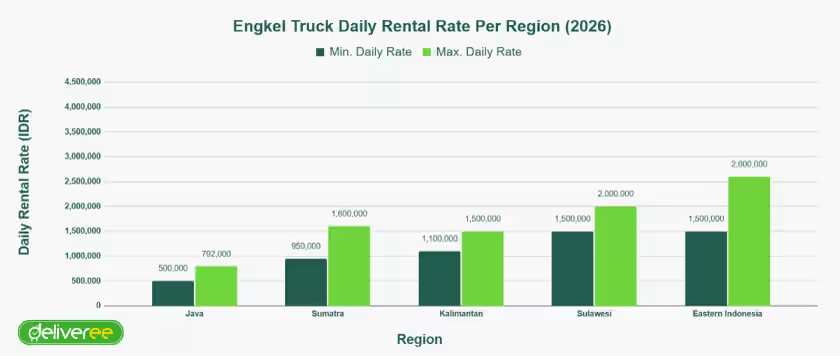
Engkel truck rental rates in Indonesia cover two sub-types with distinct rate tiers. Engkel CDE rates range from IDR 500,000 to IDR 1,200,000 per day for in-city usage and from IDR 792,000 to IDR 2,500,000 per intercity trip on major Java routes. Engkel CDD rates range from IDR 1,000,000 to IDR 1,500,000 per day on Java, with both sub-types rising to higher rates outside Java depending on regional fleet supply and fuel costs. Engkel rental rates sit at the lowest tier of the truck rental price hierarchy. The engkel CDE is a 2-axle light truck with a 2,000 to 3,000 kilogram cargo capacity. The engkel CDD carries up to 8,000 kilograms. Both are the smallest classes available for commercial hire, so their fuel consumption, toll classification, and driver day-rates all operate at the minimum cost scale. Jabodetabek has the highest concentration of active engkel fleet operators per province, with most providers maintaining CDE and CDD fleets across the metro area. This makes Jabodetabek and Bandung City the consistently cheapest engkel rental locations nationally.
| Variant | Basis | Rate (IDR) | per KM (IDR) | Cargo | Region |
| CDE Flatbed | Daily | 500k – 1.2m | 3,000 – 5,000 | 3,000 kg | JKT, BDG, SBY |
| CDE Box | Trip | 792k – 2.5m | 4,500 – 6,000 | 3,000 kg | Java Intercity |
| CDD Flatbed | Daily | 1m – 1.5m | 5,000 – 9,000 | 8,000 kg | Java |
| CDD Box | Daily | 1m – 1.5m | 5,000 – 9,000 | 8,000 kg | Java |
| CDE Flatbed (OSJ) | Daily | 800k – 1.2m | 4,000 – 6,000 | 3,000 kg | Sumatra |
| CDE Flatbed (OSJ) | Daily | 1.1m – 1.5m | 5,000 – 8,000 | 3,000 kg | Kalimantan |
| CDE Box (East) | Daily | 1.5m – 2m | 7,000 – 12,000 | 3,000 kg | Sulawesi & East IDN |
The lowest engkel CDE rental rates nationally are in the Jabodetabek to Bandung corridor at IDR 500,000 per day. Surabaya also offers competitive in-city engkel rates at IDR 800,000 to IDR 900,000 per day because the city’s large logistics hub concentration creates strong provider competition. Outside Java, engkel rates in Kalimantan carry a 20 to 40 percent surcharge above the Java CDE open flatbed daily rate because fleet supply is lower, resupply routes for fuel and maintenance are longer, and driver availability is more constrained relative to demand. Sulawesi and Eastern Indonesia carry the highest engkel daily rates in the country. That reflects the combined effect of ferry crossing costs, limited paved road networks, and the smallest commercial truck fleet per capita of any Indonesian region.
How do Engkel Truck Rental Prices Vary by Usage and Location?
Engkel truck rental prices vary by usage and location along two separate pricing axes. Usage variables such as route distance, on-hire hours, body type, and stop count, adjust the rental cost within a given region. Location variables such as province, route type, and fleet availability zone – set the rate tier within which those usage adjustments operate. The combined effect of both axes means a shipper in Jayapura on an overtime multi-stop route pays 2 to 3 times more than a shipper in Jakarta on a standard single-destination run. The condition holds even for the same cargo weight and truck class, because location sets the rate floor before usage variables are applied.
How do Truck Rentals Rates Vary by Region in Indonesia?
Truck rental rates in Indonesia vary by region across four structural cost factors. The factors are fleet supply density, road infrastructure quality, fuel distribution cost, and provider competition. Java holds the national rate floor and Sulawesi, Papua, and Eastern Indonesia hold the highest rates nationally. These four factors together set the regional rate floor above or below the Java baseline. Java holds the lowest truck rental rates nationally because it has the highest concentration of logistics fleet operators per province, with providers maintaining active Java-wide fleets that sustain published rate minimums. Sulawesi, Papua, and Eastern Indonesia hold the highest rates because all four structural cost factors work against shippers in those regions simultaneously.
| Region | Avg Daily Rate (IDR) | Avg per KM (IDR) | Popular Trucks |
| Papua & East IDN | 1.8m – 6.5m (Daily) 10m – 17.5m (Intercity) | 15,000 – 26,000+ | Fuso, Light Trucks |
| Sulawesi | 2,000,000 – 7,000,000 | 10,000 – 25,000 | Fuso, Engkel CDD |
| Kalimantan | 1,500,000 – 5,500,000 | 8,000 – 20,000 | Fuso, Tronton Wingbox |
| Sumatra | 1,200,000 – 4,500,000 | 6,000 – 18,000 | Fuso, Engkel CDD |
| Bali & Nusa Tenggara | 1,200,000 – 4,000,000 | 5,000 – 15,000 | Engkel CDD, Fuso |
| Java | 500,000 – 3,500,000 | 3,500 – 20,000 | CDE/CDD, Fuso, Tronton |
Three regional trends summarize how truck rental rates are structured across Indonesia’s island groups. The Java-to-outer-island rate premium isn’t linear. It compounds with distance from Java. Bali and Nusa Tenggara sit only slightly above Java’s rate ceiling, while Kalimantan and Sulawesi carry structural premiums of 30 to 100 percent above equivalent Java configurations, and Papua rates can exceed Java’s maximum daily rate by 3 to 5 times for equivalent truck classes. Within Java itself, rate variation by city is driven primarily by directional demand, outbound routes from Jabodetabek toward East Java consistently cost more than return routes from Surabaya toward West Java, because Jakarta-origin freight volumes are structurally higher than East Java-origin volumes on most intercity corridors. As of March 2026, Kalimantan’s rate premium is currently accelerating above its regional historical average due to IKN construction logistics demand in East Kalimantan, creating a localized demand surge for tronton and Fuso configurations not yet matched by fleet supply growth in that region.
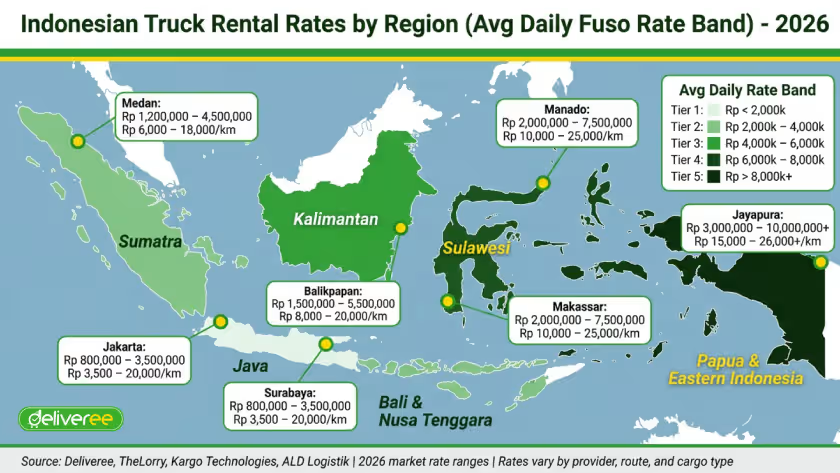
The rate gradient across the map confirms that every island group east of Java represents a distinct pricing tier, with no rate overlap between Java’s IDR 800,000 to IDR 3,500,000 band and Sulawesi’s IDR 2,000,000 to IDR 7,500,000 band at their respective midpoints. Jayapura’s IDR 3,000,000 to IDR 10,000,000 daily range sits entirely above the Java ceiling of IDR 3,500,000. The cheapest available truck rental in Papua costs more per day than the most expensive standard Java booking. Shippers operating multi-island supply chains that cross more than one rate tier in a single month face compounding regional premiums on each leg. Origin province is the single most important variable to confirm before comparing provider quotes across Indonesia.
Which Indonesian Regions have the Highest Truck Rental Rates?
The Indonesian regions with the highest truck rental rates in 2026 are Papua and Eastern Indonesia at the top, followed by Sulawesi, Kalimantan, Sumatra, and Bali. Java has the lowest rates of all five outer-island regional zones across every truck class. Geographic isolation, infrastructure constraints, and low return-trip cargo availability combine to push each outer-island region above the Java baseline, with each factor adding a compounding cost premium on top of base fuel and driver fees.
- Papua and Eastern Indonesia is the most expensive truck rental region in Indonesia because sparse road networks, limited fleet supply, and frequent multimodal logistics increase both daily and distance-based costs. Fuso rental in Papua costs IDR 3,500,000 to IDR 6,000,000 per day and IDR 15,000 to IDR 26,000 per kilometer, while engkel CDE rates reach IDR 1,500,000 to IDR 2,000,000 per day.
- Sulawesi is the second-highest pricing region, where intercity routes between Makassar, Manado, and Palu traverse mountainous terrain with limited toll roads. Fuso daily rates reach IDR 3,000,000 to IDR 5,000,000 and tronton daily rates reach IDR 4,000,000 to IDR 6,500,000. [Truck Rental in Sulawesi – Intercity Routes & Fleet Options]
- Kalimantan is the third-highest region, where engkel CDE daily rates start at IDR 950,000 to IDR 1,400,000 and tronton daily rates reach IDR 4,000,000 to IDR 6,000,000, driven by long inter-city road distances between logistics hubs – Balikpapan to Samarinda for 120 kilometers long and Balikpapan to Banjarmasin for 570 kilometers long. Logging and mining industries drive high truck demand, but fragmented road conditions between coastal cities and inland areas add time and fuel surcharges. [Truck Rental in Kalimantan – Mining and Industrial Logistics Rates]
- Sumatra is the fourth-highest truck rental rate zone in Indonesia, where Fuso daily rates reach IDR 2,000,000 to IDR 4,000,000 and tronton daily rates reach IDR 3,500,000 to IDR 5,500,000, approximately 30 to 50 percent above Java benchmarks.
- Bali and Nusa Tenggara is the fifth-highest truck rental rate zone in Indonesia, where engkel CDD daily rates reach IDR 800,000 to IDR 1,200,000 and Fuso daily rates reach IDR 1,500,000 to IDR 4,000,000, 10 to 20 percent above Java benchmarks for most truck classes. For ferry route pricing across truck classes, read Truck Rental from Bali to Lombok. [Truck Rental from Bali to Lombok – Ferry Route Pricing Guide]
How does Intercity Distance Affect Regional Truck Rental Pricing?
Intercity distance increases the total trip cost for every truck class on every regional route in Indonesia, but decreases the effective per-kilometer rate. Longer routes cost more but are progressively cheaper per kilometer traveled, because the fixed cost components of a truck rental contract, such as driver commission, vehicle preparation, and base daily rate, are distributed across a greater number of kilometers as route distance increases. On Java intercity corridors, a Fuso truck on the Jakarta-Bandung route at 148 kilometers generates an effective per-kilometer rate of IDR 15,608, derived from IDR 2,310,000 divided by 148 kilometers. The same Fuso on the Jakarta to Surabaya route at 800 kilometers generates IDR 10,000 per kilometer, derived from IDR 8,000,000 divided by 800 kilometers. That is 36 percent lower per kilometer on the longer route, despite the absolute trip cost being 2.5 times higher in total.
The total trip cost on a regional intercity route is the sum of four measurable components. They are the base daily rate, the per-kilometer distance charge, toll fees by axle class from Golongan III (buses and light 2-axle commercial vehicles) to Golongan V (multi-axle heavy trucks) as classified under Indonesia’s national toll tariff system, and any sea crossing fees on cross-island routes. As route distance increases, the daily rate component becomes a smaller share of the total cost and the per-kilometer distance charge becomes the dominant cost driver. That’s why providers shift from daily rate billing to per-kilometer rate billing for routes above 400 to 500 kilometers on Java intercity corridors.
Four Fuso intercity routes from Jakarta show how increasing distance shifts the cost structure from base-rate-dominant to per-kilometer-dominant across Indonesia’s main freight corridors. Route data is sourced from Deliveree’s published long-haul fleet pricing, with fleet utilization benchmarks from APTRINDO, which identifies the Fuso as Indonesia’s most widely operated medium-duty intercity freight truck.
| Route | Distance | Base Rate (IDR) | Add-on / KM | Toll/Ferry | Est. Total |
| Jakarta – Bandung | ~148 km | 1,400,000 | 830,000 | 80,000 | ~2,310,000 |
| Jakarta – Semarang | ~450 km | 1,750,000 | 2,240,000 | 510,000 | ~4,500,000 |
| Jakarta – Surabaya | ~800 km | 2,850,000 | 5,010,000 | 140,000 | ~8,000,000 |
| Jakarta – Medan | ~1,700 km | 8,500,000 | Incl. All; ferry applies | + Ferry | ~21,000,000 |
On short routes under 300 kilometers such as Jakarta to Bandung, the base charge dominates the total cost. The per-kilometer variable adds a relatively minor increment, IDR 830,000 across 148 kilometers on that corridor. The rate structure at this distance range is most competitive because the truck can return to its origin within the same working day, eliminating overnight driver costs and empty-return surcharges.
Routes exceeding 600 kilometers, particularly cross-province or cross-island corridors, can produce non-linear total cost growth. The Jakarta to Surabaya route at approximately 800 kilometers costs approximately 3.46 times more than Jakarta to Bandung at approximately 148 kilometers, despite being 5.4 times the distance. At approximately 1,700 kilometers, a Fuso truck on the Jakarta to Medan route costs IDR 21,000,000. The ferry crossing from Java to Sumatra adds a fixed multimodal surcharge on top of the per-kilometer structure. Treat any route over 500 kilometers as a separate pricing tier. The per-kilometer cost structure shifts non-linearly above this threshold, making short-haul rate comparisons an unreliable model for cross-province route budgeting.
How does Truck Tye and Cargo Capacity Affect Rental Costs?
Truck type and cargo capacity directly determine rental costs in Indonesia because every truck class in the national fleet rental market is priced against a cargo capacity threshold. As cargo capacity increases from 3,000 kilograms on the CDE to 25,000 kilograms on the tronton wing box, the daily rental rate increases proportionally. Three compounding cost variables drive that increase. They are vehicle procurement cost, fuel consumption ratio, and commercial driver certification requirements. Truck type affects rental costs above and beyond cargo capacity because the body configuration, such as open flatbed, wing box, or container, adds specialized handling certification, insurance premiums, and loading equipment requirements that raise the daily rate for enclosed and specialized body types above an open flatbed of equivalent payload class.
The Deliveree fleet pricing indicates that the cost per kilogram of capacity decreases from IDR 750 per kilogram for a small box truck to IDR 250 per kilogram for fuso, which represents a 67 percent reduction as cargo capacity scales upward. On Deliveree’s long-haul FTL service, the same step-function pattern applies across intercity corridors. On the Bandung to Jakarta route, Deliveree’s fuso rent prices vary from IDR 1,650,000 and tronton at IDR 3,700,000 per trip.
Deliveree charges IDR 900,000 per 10-hour day for engkel CDE Box or Pickup in Jabodetabek and IDR 640,000 per 8-hour day outside Jabodetabek. On the long-haul Solo to Jakarta corridor, Deliveree’s engkel box is priced at IDR 3,250,000 per trip versus IDR 2,500,000 for a Pickup on the same route, with the IDR 750,000 premium reflecting the engkel Box body type’s higher vehicle depreciation and insurance premium relative to the open Pickup configuration. For Fuso, Deliveree charges IDR 2,000,000 per 10-hour day in Jabodetabek and IDR 1,450,000 per 8-hour day outside Jabodetabek. Intracity bookings include a cargo area of 34.2 cubic meters with unlimited stops within a 50 kilometer radius of the pickup address under standard service terms. Tronton bookings on Deliveree’s long-haul FTL network show the widest intercity rate spread in the fleet, with Deliveree charging IDR 3,700,000 for Bandung to Jakarta, IDR 7,550,000 for Jakarta to Solo, and IDR 4,798,800 for Bandung to Solo. Each rate is inclusive of vehicle, driver, fuel, tolls, and parking per confirmed trip.
Cost vs. Cargo Trade-off
The daily rental rate increases with each cargo capacity class, but the cost per kilogram of capacity consistently decreases, meaning larger trucks cost more per day in absolute IDR terms but deliver more cargo value per IDR spent. For cargo under 3,000 kilograms, engkel CDE at IDR 900,000 per day maximizes cost efficiency. Booking a Fuso for a 1,500 kilogram load pays IDR 350,000 per day more while leaving 8,500 kilograms of paid capacity unused. For cargo between 5,000 and 6,000 kilograms, renting a CDD at IDR 1,100,000 per day closes the cost gap between engkel and Fuso; splitting across two engkel bookings at IDR 1,800,000 combined costs IDR 700,000 per day more than a single CDD trip at equivalent total weight. For cargo between 8,000 and 10,000 kilograms, Fuso at IDR 2,000,000 per day produces the lowest cost per kilogram in Deliveree’s Jabodetabek intracity fleet at IDR 250 per kilogram, calculated at 8,000 kilograms of declared load against Fuso’s 10,000 kilogram maximum. The trade-off becomes critical when declared cargo weight falls significantly below the truck’s limit. Every underloaded booking pays the full daily rate for unused capacity, making the actual cost per kilogram of delivered cargo higher than the truck’s theoretical rate per kilogram figure.
How does Truck Size Influence Overall Rentals Pricing?
Truck size directly and consistently increases overall rental pricing. Engkel CDE carries the lowest daily rental rate, from IDR 500,000 to IDR 1,200,000, fuso sits in the middle tier, from IDR 1,200,000 to IDR 3,000,000, and tronton commands the highest rate from IDR 1,800,000 to IDR 6,500,000. The pricing schema following a staircase pattern where each size class is approximately 1.4 to 2 times more expensive per day than the class below it. The per-kilometer rate follows the same hierarchy, but compresses more aggressively on long-haul routes for larger trucks because their higher fixed cost base benefits proportionally more from being distributed across a greater number of kilometers.
The size-pricing relationship operates through five direct mechanisms. Fuel consumption is the most direct mechanism. Larger trucks consume more fuel per kilometer, and a tronton’s fuel cost per trip runs significantly higher than a fuso’s on an identical route, with that cost embedded into the rate rather than charged separately on all-in platforms like Deliveree. Driver qualification compounds this further because tronton and fuso drivers hold higher commercial license classifications than engkel drivers, commanding a higher day rate that providers build directly into the truck’s daily rental price. The day rate is a fixed daily expense that applies regardless of route distance. Maintenance and depreciation add a third layer because larger trucks carry higher per-day overhead due to more complex drivetrains, heavier axle loads, and higher component replacement costs. The factors are spread across daily rental rates, making the daily rate for a tronton structurally higher than an engkel even when both are idle. Cargo body specification also raises the rate independently of size class, since wing box and box configurations command a higher daily rate than open flatbed configurations of the same truck because enclosed and side-opening bodies add dock-loading access, weather protection, and cargo security. A tronton wing box consistently costs more than a tronton open flatbed on the same route. Toll axle classification is the fifth mechanism. Tronton trucks classified as Golongan V pay IDR 40,000 to IDR 70,000 per gate section, versus IDR 30,000 to IDR 50,000 for engkel trucks classified as Golongan IV. That difference compounds across every gate section on long-haul corridors.
The data confirms two patterns simultaneously. The per-kilometer rate at the Bandung route is consistently higher than the Surabaya route for every truck size class, confirming the fixed-cost compression effect of longer distances. The per-kilometer premium between CDE and tronton on the Bandung route is larger than on the Surabaya route, confirming that long-haul routes partially narrow the per-kilometer gap between small and large truck classes.
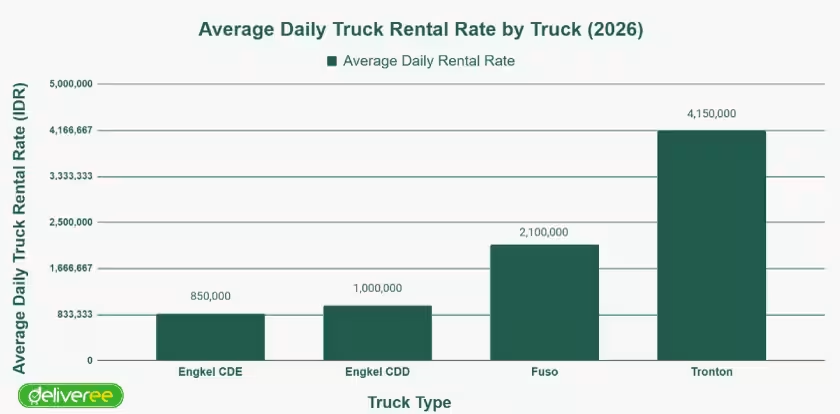
The chart showcases the staircase pattern. Engkel CDE to CDD is a modest IDR 150,000 step, but the jump from CDD to Fuso is IDR 1,100,000 and from Fuso to tronton is another IDR 2,050,000. The acceleration isn’t arbitrary. The price reflects the compounding weight of higher fuel consumption, stricter driver licensing, heavier axle maintenance, and Golongan V toll classifications all landing simultaneously at the tronton class. Shippers who treat truck selection as a simple capacity decision without accounting for that cost acceleration consistently overpay. The right truck isn’t the one that fits the cargo, it’s the one where the daily rate and the declared load produce the lowest cost per kilogram of cargo actually delivered.
Does Cargo Weight Increase the Rental Cost for Each Truck Type?
No, cargo weight does not increase the rental cost for each truck type in Indonesia as long as the load stays within the truck’s rated payload limit. A shipper loading 5,000 kilograms into a fuso pays the same daily or per-trip rate as one loading 10,000 kilograms into the same truck. Cost only increases under three specific conditions. They are when cargo weight forces a truck class upgrade, when overloading triggers Zero ODOL fines and legal liability, and when specialized cargo such as hazardous materials, oversized machinery, or temperature-controlled goods requires permits, handling equipment, or certified drivers that carry per-booking fees above the base daily rate.
The weight-related cost increase applies in three specific scenarios. First, when cargo weight requires a larger truck class than originally planned, forcing a class upgrade. Second, when overloading triggers ODOL fines and legal liability for the shipper. Third, when specialized cargo such as hazardous materials, oversized machinery, or temperature-controlled goods requires permits, specialized handling equipment, or certified drivers, those requirements carry per-booking fees that increase the total rental cost above the base daily rate.
For engkel CDE with a 2,000 to 3,000 kilogram rated payload, weight only affects cost if cargo exceeds 3,000 kilograms, at which point a CDD is required. At Deliveree, a CDE Box on the Jakarta to Bandung route costs IDR 792,000 with no per-kilogram surcharge within the rated limit. For CDD with a 5,000 to 8,000 kilogram rated payload, weight stays cost-neutral within range. A CDD Box Jakarta to Surabaya costs IDR 3,500,000 regardless of whether you load 4,000 kilograms or 7,500 kilograms, and exceeding 8,000 kilograms forces a class upgrade to Fuso. For Fuso with an 8,000 to 10,000 kilogram rated payload, a fuso box trip from Jakarta to Surabaya costs IDR 6,200,000 at any load from 1 kilogram to 10,000 kilograms. Beyond 10,000 kilograms, the shipper must upgrade to tronton, adding approximately IDR 1,800,000 to the same route. For tronton with an 18,000 to 25,000 kilogram rated payload, a tronton wing box trip from Jakarta to Surabaya costs IDR 8,010,000 at full or partial load, making load maximization the most effective way to reduce cost per kilogram when renting at this class.
On Deliveree, cargo weight operates differently from the broader market. Deliveree’s all-in fixed-price FTL service doesn’t apply a variable per-kilogram or per-ton cargo weight tariff as part of the booking price, meaning the quoted trip price for a fuso at IDR 2,000,000 per day or a Bandung to Jakarta trip at IDR 1,650,000 covers the vehicle, driver, fuel, tolls, and parking at a fixed rate regardless of whether the shipper loads 2,000 kilograms or the truck’s full cargo payload. The declared cargo must not exceed the vehicle’s legal payload limit. Shipments found to exceed the truck’s cargo limit at the loading point are subject to load rejection, rebooking to a higher-capacity truck class at the applicable higher fleet rate, or provider-applied overload fees. On Deliveree, cargo weight increases rental cost specifically when it forces a truck class upgrade, not through a per-kilogram tariff applied within the cargo limit threshold.
Tip: Maximizing Payload Efficiency Because rental cost is fixed per trip, maximizing how much cargo you load per booking directly reduces your cost per unit shipped.
|
How Does Rental Duration Affect Truck Rental Pricing?
Rental duration affects truck rental pricing in Indonesia by reducing the effective daily cost as contract length increases. An engkel CDE on a single-day booking costs IDR 500,000 to IDR 1,200,000 per day, while the same truck under a monthly contract costs IDR 320,000 to IDR 400,000 per effective operating day at 25 working days per month, a reduction of 43 to 57 percent without changing the truck class or route. The effective daily rate reduction applies across all four truck classes covered, Engkel CDE, engkel CDD, fuso, and tronton, with monthly savings ranging from 40 to 57 percent against the standard single-day booking rate, based on 2026 market data from Indonesian logistics providers. The chart shows each truck class’s standard daily rate range against its monthly effective daily rate. Monthly effective daily rates in the chart are calculated at 25 operational working days per month. Indonesian logistics providers price monthly truck rental contracts at a lower marginal cost per day because the guaranteed deployment period eliminates driver idle-day costs, vehicle repositioning fees, and fleet administration overhead. Single-day bookings recover all three costs in full from the shipper on every individual booking.
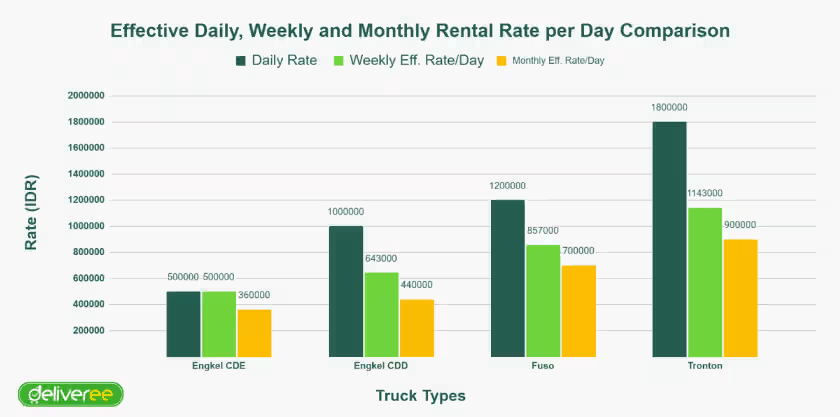
The proportional savings are widest for engkel CDE contracts at 43 to 57 percent and narrowest for fuso contracts at 40 to 47 percent. Two variables determine where a specific contract falls within the published savings range. The first is booking period, contracts confirmed before Indonesia’s peak freight windows lock in base rates before seasonal surcharges are applied. The second is departure region, where Kalimantan and Sulawesi monthly contracts carry higher absolute rates than Java contracts for the same truck class. Shippers running 15 or more confirmed delivery days per month on a recurring route reduce per-day truck rental cost most directly by moving from single-day bookings to a monthly contract, before adjusting truck class, route distance, or cargo weight.
What Are The Cost Differences between Daily and Monthly Truck Rentals?
The cost difference between daily and monthly truck rentals ranges from 33 percent to 58 percent savings in effective daily rateThe cost difference between daily and monthly truck rentals ranges from 33 to 58 percent savings in effective daily rate. A shipper who commits to a monthly contract consistently pays between one-third and nearly three-fifths less per operating day compared to booking the same truck type daily. The precise savings within that range are determined by three factors, which are the truck type booked, the season when the booking happened, and the region. Savings percentages are derived by comparing each truck type’s midpoint daily rate against the midpoint effective monthly daily rate at 30 operating days per month.
| Truck Type | Daily (IDR) | Monthly (IDR) | Eff. Daily | Saving (%) | Best For |
| Engkel CDE | 500k – 1.2m | 8m – 10m | 267k – 333k | 50 – 58% | UMKM daily intra-city, last-mile. |
| Double CDD | 1m – 1.5m | 10m – 12m | 333k – 400k | 50 – 58% | FMCG delivery, e-commerce returns. |
| Fuso | 1.2m – 3m | 15m – 20m | 500k – 667k | 33 – 55% | Fixed weekly intercity routes. |
| Tronton | 1.8m – 6.5m | 20m – 25m | 667k – 833k | 33 – 58% | Industrial, construction, bulk FMCG. |
Truck type is the strongest predictor of where a contract falls within the savings range. Engkel CDE monthly contracts save IDR 4,500,000 to IDR 8,000,000 per month against equivalent daily bookings. CDD contracts save IDR 6,000,000 to IDR 12,000,000 per month on the same comparison. Fuso and tronton monthly contracts sit at 33 to 58 percent savings, or IDR 5,000,000 to IDR 10,000,000 per month. Monthly contracts signed during off-peak periods (typically February to March and August to September) lock in lower rates before Eid al-Fitr and year-end surcharges take effect, while contracts negotiated during the Eid al-Fitr run-up carry a 10 to 15 percent premium above the off-peak rate. Java monthly rates at IDR 8,000,000 to IDR 25,000,000 form the national baseline, with Kalimantan and Sulawesi carrying an estimated monthly rate of IDR 12,000,000 to IDR 40,000,000 for equivalent truck classes, though the 33 to 58 percent proportional savings structure applies consistently across all island groups because the discount mechanism is provider economics, not geography.
What Additional Services can Increase Truck Rentals Pricing?
Additional services, such as helpers, cargo insurance, fuel and toll reimbursements, permits, and port handling fees, increase truck rental pricing beyond the base daily or per-route rate by adding charges for labor, protection, compliance, and operational logistics that the standard booking does not cover. Deliveree’s standard truck booking includes the driver, vehicle, fuel, basic loading and unloading within 15 meters, and basic cargo insurance, but every service need that falls outside these included items triggers an additional fee that is either charged at booking or reimbursed by the shipper after the trip.
- Cargo Insurance: A financial protection policy covering physical loss or damage to cargo carried on the rented truck from origin to delivery destination, issued either by the logistics provider’s in-house insurance partner or an independent cargo insurer. Cargo insurance is priced at 0.1 to 0.3 percent of the declared cargo value per trip or at a flat per-trip premium of IDR 50,000 to IDR 200,000. Basic cargo insurance up to a standard limit is included in Deliveree’s standard booking through its default coverage tier.
- Fuel and Toll Reimbursements: The cost of diesel consumed during the rental period, either pre-included or passed through to the renter at pump price. Fuel is included in Deliveree’s standard booking rate. Toll and parking fees are included up to IDR 100,000 per booking for all truck classes and up to IDR 50,000 for car-class vehicles. Any toll or parking cost above these limits must be pre-approved by the shipper and is reimbursed to the driver either in cash or through the app payment.
- Permits, Port Handling, and Ferry Crossing Fees: Port labor handling fees are paid for by the truck driver on the shipper’s behalf and are reimbursed afterwards. For deliveries requiring access to port facilities or bonded warehouse zones, ferry crossing fees are handled the same way.
Each of these add-ons can silently widen the gap between the rate you see at booking and the total you actually pay. Knowing which ones apply to your specific route and cargo type is the only way to keep that gap under control.
Which Add-on Services Commonly Affect the Total Rental Cost?
Loading and unloading assistance, toll fees above the included limit, extra helpers, document return handling, and Tenaga Kerja Bongkar Muat (TKBM) port labor fees and ferry fees are the five add-on service categories that most commonly increase the total truck rental cost above the base booking rate in Indonesia. Each of these services applies to a predictable set of cargo scenarios, making them foreseeable costs that shippers can budget for in advance rather than surprise charges discovered at invoice.
- Loading or unloading beyond 15 meters: The per-person, per-trip fee charged for physically loading cargo onto the truck at the pickup point and unloading it at the delivery destination. Standard loading and unloading within 15 meters of the vehicle is included at no extra charge on Deliveree bookings.
- Extra helper: An additional person beyond the driver who assists with loading, unloading, navigating narrow access points, and managing multi-stop deliveries. When cargo requires two people for safe handling, shippers can add an extra helper through Deliveree’s app. The helper fee on the engkel CDD is IDR 90,000 per helper for 1 to 5 destinations and IDR 125,000 for 6 plus destinations.
- Toll and parking fees above the included limit: Toll fees are per-gate-section charges applied to every truck entering Indonesia’s national toll highway network, classified by axle weight from Golongan II to Golongan V. Parking fees are per-location charges incurred when the truck parks at a delivery site. Deliveree includes up to IDR 100,000 in combined tolls and parking per booking for all truck classes, with any overage reimbursed by the shipper after the trip.
- Ferry crossing fees: Port labor fees apply to deliveries entering bonded warehouse zones, container depots, or port facilities where registered labor unions control loading and unloading; ferry crossing fees apply to routes requiring short water crossings. In Deliveree, both port and ferry fees are paid by the driver on the shipper’s behalf and fully reimbursed based on valid receipts.
Toll overage and loading labor cause the most invoice surprises because shippers assume both are covered in the base rate. On a Jakarta to Surabaya Fuso trip, toll overage alone adds IDR 250,000 to IDR 350,000 above the included limit, and two helpers on a six-stop CDD route add another IDR 250,000 in helper fees. Before confirming any booking, verify four things: the toll inclusion limit, whether loading labor is in scope for the contract type, how many helpers the cargo and stop count actually require, and whether the route involves port entry. Shippers who confirm these upfront treat them as fixed budget line items rather than charges discovered at invoice.
What Payment Options are Available for Truck Rental Services?
Truck rental providers in Indonesia accept four main payment options which are cash, bank transfer, e-wallet, and business invoice credit. The payments options are all offered by Deliveree, while local independent truck owners typically accept cash and bank transfer only. Knowing which payment method your provider accepts before booking eliminates last-minute delays at the point of dispatch, particularly for tronton and Fuso bookings where total amounts frequently exceed IDR 3,000,000 to IDR 8,000,000 and cash transactions become logistically inconvenient.
The four payment options available for truck rental services in Indonesia are:
- Cash, the most widely accepted method across all provider types in Indonesia. Cash is settled directly with the driver or dispatched through the provider’s payment flow on platform-based bookings. It requires no bank account, no internet connection, and no prior registration, which makes it the default payment choice for one-time or infrequent shippers using smaller logistics providers in secondary cities and outer island regions.
- Bank transfer and virtual account is the dominant digital payment method in Indonesia’s logistics sector. Bank transfers are initiated before pickup for new or one-time shippers, or after delivery under pre-approved credit terms for recurring corporate clients. Virtual accounts assign a unique payment code per booking that auto-confirms payment on receipt.
- E-wallet or electronic wallet payment is supported by Indonesia’s five leading wallets which are GoPay, OVO, DANA, ShopeePay, and LinkAja. E-wallet payment is increasingly accepted by logistics platforms as a payment option. E-wallet payment is completed inside the booking app by selecting the e-wallet option, which redirects to the wallet’s authorization screen for one-tap confirmation.
- Business invoice credit through Deliveree’s prepaid credit option lets shippers top up a Deliveree account balance via direct bank transfer and use it for future bookings without re-entering payment details each time. Deliveree Business Account holders can access invoice-based payment with payment terms. The Deliveree Business Account enables high-volume shippers to receive a consolidated monthly invoice rather than paying per-booking.
Payment method choice is a provider compatibility decision as much as a personal preference. Cash works everywhere but gets impractical fast on tronton and fuso bookings where totals hit IDR 3,000,000 to IDR 8,000,000 and handling large bills at dispatch creates unnecessary delays. Bank transfer and virtual account cover the majority of formal provider bookings across Indonesia. E-wallet and business invoice credit apply only when booking through a platform that supports them, which currently means platform-based providers like Deliveree rather than independent local operators. Shippers who book regularly should consider Deliveree’s Business Account specifically to cut per-booking payment friction and consolidate multiple trip costs into a single monthly invoice instead of settling each delivery separately.
Which Payment Methods are Commonly Accepted for Truck Rentals?
The most commonly accepted payment methods for truck rentals in Indonesia are cash, bank transfer, e-wallet, and business invoice credit, with availability varying by provider type.
- Cash, payment that is accepted by all provider types including open-market local operators, independent truck owners, and platform-based logistics companies. No bank account, internet connection, or prior registration required.
- Bank transfer and virtual account is universally accepted by formal truck rental companies and platform-based providers. Virtual accounts assign a unique payment code per booking that auto-confirms payment on receipt.
- E-wallet payment is accepted by platform-based providers only. GoPay, OVO, DANA, ShopeePay, and LinkAja are the five leading e-wallets accepted on logistics platforms in Indonesia.
- Business invoice credit is available through Deliveree’s Business Account program only. Consolidates multiple bookings into a single monthly invoice with Pajak Penghasilan Pasal 23 (PPh 23) withholding tax applied before transfer, as required under Indonesia’s Directorate General of Taxes regulations for service fee transactions.
Open-market local operators strongly prefer cash because it settles trip revenue immediately at the point of delivery without any reconciliation overhead. Formal truck rental companies with recurring corporate clients prefer bank transfer because it produces the VAT documentation required for registered business transactions and allows receivables management through standard accounting software with virtual account auto-reconciliation. Platform-based providers like Deliveree support all four methods, with the Business Account option designed specifically for high-volume shippers who need consolidated billing and tax invoice cycles rather than per-booking settlement.
What are the main factors that affect Truck Rental Costs in Indonesia?
The main factors that affect truck rental costs in Indonesia are truck type, route distance, cargo weight and volume, rental duration, and departure region. Each factor independently shifts the total cost, and when two or more factors interact in the same booking, their combined effect determines the final rate. Understanding each factor individually before booking prevents the most common and costly mismatches in Indonesian logistics planning. The three most frequent mismatches are choosing the wrong truck class, underestimating route distance costs, and booking on-demand when a duration contract would reduce the effective daily rate by 40 to 57 percent depending on truck class and contract length.
- Truck type, the single most visible cost factor at the point of booking. Each truck class carries a different base daily rate: engkel CDE at IDR 500,000 to IDR 1,200,000 per day, Fuso at IDR 1,200,000 to IDR 3,000,000 per day, and tronton at IDR 1,800,000 to IDR 6,500,000 per day. Those rate differences reflect each class’s fuel consumption, driver qualification tier, and cargo body specification. Choosing a truck class one tier above what cargo weight requires wastes IDR 400,000 to IDR 800,000 per trip without adding any freight-carrying benefit.
- Route distance drives total cost on per-route bookings and compresses the per-kilometer rate as distance increases. A CDE on the Bandung to Jakarta corridor at 148 kilometers costs IDR 835,000 at IDR 5,628 per kilometer, while a CDE on the Jakarta to Surabaya corridor at approximately 800 kilometers costs IDR 2,500,000 at IDR 3,125 per kilometer. Longer routes cost more in absolute terms but less per kilometer because fixed operational costs distribute across more kilometers.
- Cargo weight and volume that fits within the contracted truck’s payload limit doesn’t add cost above the base rate. Cargo that exceeds the limit triggers a mandatory truck class upgrade or an ODOL violation penalty, both of which increase total cost. Cargo with high volume but low weight, such as foam, textiles, or empty packaging, may require a larger cargo body than the weight alone suggests, again triggering an upward truck-class adjustment.
- Rental duration for daily on-demand bookings carry the published rate ceiling. Weekly contracts reduce the effective daily rate by 14 to 29 percent below the standard single-day rate, while monthly contracts reduce it further depending on truck type. Based on 2026 Indonesian market rates, monthly contracts reduce the effective daily cost to IDR 360,000 for engkel CDE, IDR 440,000 for engkel CDD, IDR 700,000 for Fuso, and IDR 900,000 for tronton, compared with single-day rates of IDR 500,000 to IDR 1,200,000 for engkel CDE, IDR 1,200,000 to IDR 3,000,000 for Fuso, and IDR 1,800,000 to IDR 6,500,000 for tronton.
- The departure region creates major structural costs above the Java baseline, which persist regardless of truck type, distance, or duration. Java serves as the national price benchmark. Meanwhile, truck rental costs from areas outside Java can increase severalfold.
Truck type and region are the two factors that create the widest cost variance on any single booking. A tronton departing from Papua on a daily contract costs more than ten times what an engkel CDE on a standard Java city route costs, even before distance, cargo weight, or overtime enter the calculation. Distance, cargo weight, and rental duration are largely within the shipper’s control before the booking is confirmed. Getting those three right before selecting a truck class is the practical sequence that keeps the final invoice close to the quoted base rate.
Which Cost Components have the Greatest Impact on Truck Rental Pricing?
Fuel cost, distance-driven per-kilometer charges, truck type selection, add-on service fees, and seasonal demand are the five cost components with the greatest measurable impact on the total truck rental invoice in Indonesia. These five components collectively account for 70 to 85 percent of the final invoice, with the remaining 15 to 30 percent attributable to fixed overhead such as driver wages, toll pass-through, and insurance. The two ranges are inversely linked and together always sum to 100 percent.
- Fuel cost, The single largest operational variable in Indonesian truck rental pricing, representing 40 to 50 percent of the per-kilometer rate on intercity routes. Fuel cost is the primary component of the per-kilometer charge and is listed separately here because fuel-excluded contracts bill it as an independent invoice line item.
- Distance-driven per-kilometer charge,The variable rate that accumulates progressively with every kilometer of the route, added on top of the fixed daily base rate. Per-kilometer rates range from IDR 3,000 to IDR 5,000 per kilometer for engkel-class trucks to IDR 10,000 to IDR 19,000 per kilometer for tronton-class trucks on market-average contracts.
- Truck type and class selection, The vehicle class chosen at booking sets the base rate floor for the entire job. Upgrading one class from CDD to Fuso adds approximately IDR 400,000 to IDR 800,000 to the daily base rate and IDR 1,500 to IDR 2,500 per kilometer to the per-kilometer charge. On a Jakarta to Surabaya route, this class upgrade translates to a total cost increase of approximately IDR 2,700,000 per trip.
- Add-on services, Itemized surcharges beyond the vehicle rate, including tolls, cargo insurance, helper labor, waiting time, and permit costs, that collectively add IDR 500,000 to IDR 2,500,000 to a typical intercity booking depending on route complexity and service inclusions. Driver overtime fees, which apply when the total on-hire period extends past the contracted daily window, contribute IDR 50,000 to IDR 200,000 per additional hour beyond the agreed limit.
- Seasonal Demand, A time-based cost multiplier that increases daily and per-kilometer rates during Indonesia’s peak logistics periods, including Eid al-Fitr and the November to January year-end cycle.
Fuel cost and distance together account for the bulk of what moves the final invoice on any intercity booking. Truck class, add-on services, and seasonal timing are decisions the shipper controls before dispatch.







 Chat
Chat