









Land shipping services are ground-based freight transportation solutions that move goods overland using road vehicles such as trucks, pickup vans, and container trucks. Land shipping connects manufacturers, warehouses, retailers, and end customers across road networks, handling the core distribution layer in domestic logistics operations. Land shipping serves as the primary logistics backbone for B2B supply chains, eCommerce fulfillment, and freight distribution in Indonesia, where road transport accounts for approximately 50% of total domestic logistics costs.
B2B supply chains rely on land shipping to move raw materials and finished goods between factories, distribution hubs, and retail points. eCommerce sellers use land cargo services for last-mile delivery across Java, Sumatra, and other islands. Freight forwarders integrate land transport as the ground leg connecting ports and warehouses to final destinations.
Deliveree Indonesia provides land shipping services through a technology-driven logistics marketplace, connecting businesses with qualified drivers operating commercial vehicles for both intracity deliveries and long-haul city-to-city routes.
What is Land Shipping?
Land shipping is the transportation of goods overland using vehicles such as trucks, pickup trucks, and box cars, connecting origins to destinations through ground routes without involving sea or air transport modes. The World Bank classifies road transport as the primary domestic freight mode in archipelago economies like Indonesia, where overland vehicles complete the inland distribution legs that port and airport infrastructure cannot efficiently reach.
Land shipping works by mobilizing a fleet of ground vehicles to execute a structured operational cycle consisting of pickup, transit, and final delivery. Land shipping functions by assigning a specific vehicle type based on the shipment’s weight and volume, then utilizing established road networks and routing software to navigate from the point of origin, such as a warehouse or seaport, to the recipient’s specific address. By integrating real-time dispatching and GPS tracking, land shipping converts physical road infrastructure into a flexible logistics pipeline that provides the last-mile connectivity other transport modes cannot achieve directly.
Land shipping serves as the primary distribution backbone in Indonesia. Road infrastructure spanning toll networks across Java and Sumatra allows cargo to move between cities, warehouses, and end customers faster than any alternative domestic mode for most inland routes.
Land shipping operations in Indonesia typically progress through three core stages. The first stage is pickup, where a vehicle collects cargo from the sender’s location, a warehouse, or a distribution point. The second stage is transit, where goods move overland along planned routes toward the destination region. The third stage is delivery, where the vehicle completes the final leg and hands off cargo to the recipient at the specified address.
Warehousing consolidates incoming cargo at a staging point before dispatch, ensuring goods are sorted, documented, and ready for loading. Dispatching assigns the right vehicle type and driver based on cargo weight, volume, and delivery urgency. Routing selects the most efficient road path based on distance, toll access, and regional conditions across the delivery corridor. Delivery executes the final handoff at the destination, often with proof of receipt collected through the driver’s mobile application.
Land shipping operates as the ground-execution layer inside multimodal freight networks, completing inland legs that sea and air transport cannot handle directly. In Indonesia, road transport accounts for approximately 85% of domestic cargo movement by volume, making land freight the structural foundation of the national supply chain.
What are the Components of a Land Cargo Service?
A land cargo service runs on five components, which are vehicles, drivers, dispatch and routing systems, warehouses, and tracking systems. Each component carries a specific function, and a failure in any one of them directly affects delivery speed, cargo safety, and overall service reliability. The Indonesian Logistics Association (ALFI) identifies vehicle assets, human capital, technology systems, and infrastructure as the four pillars of operational land freight capability.
- Vehicles: Vehicles are the physical carriers that transport cargo across road networks. Deliveree Indonesia operates a fleet of 10 vehicle classes, from economy cars carrying up to 200 kg for small urban deliveries, to Tronton Wing Box trucks carrying up to 25,000 kg for heavy freight loads. Businesses pick the vehicle class that matches their cargo weight and volume, keeping cost proportional to need.
- Drivers: Drivers are the operators responsible for cargo pickup, safe transit, and confirmed delivery at the destination point. A qualified driver knows the route, handles cargo loading and unloading, and communicates directly with the sender or receiver. Driver performance directly shapes whether a shipment arrives on time and in the right condition.
- Dispatch and routing systems: Dispatch and routing systems are the digital tools that assign vehicles to jobs, plan road routes, and manage delivery schedules. Logistics platforms use these systems to reduce empty mileage, avoid traffic congestion, and improve delivery efficiency. In Indonesia, route optimization tools reduce fuel costs by up to 18% compared to manually planned routes.
- Warehouses: Warehouses are the storage facilities where goods are held before dispatch or after arrival. Warehouses serve as the operational staging point in a land shipping flow, where cargo is sorted, consolidated, labeled, and prepared for the next leg of the journey. Most B2B and eCommerce operations in Indonesia maintain at least one warehouse hub in a major city like Jakarta, Surabaya, or Medan before dispatching outbound freight.
- Tracking systems: Tracking systems are GPS-based tools that monitor vehicle location, speed, and route progress in real time. Senders and receivers use tracking data to verify where a shipment is during transit and estimate arrival windows.
Land cargo service components don’t operate in isolation. The components connect through a logistics management layer that coordinates when and how cargo moves, and the coordination layer is what turns a collection of trucks and warehouses into a functioning freight operation.
How do Supply Chain Management Systems Support Land Shipping Operations?
Supply chain management (SCM) systems support land shipping operations by connecting inventory data, warehouse activity, and truck fleet scheduling inside one coordinated platform. SCM systems give logistics managers real-time visibility across three core operational layers, which are inventory coordination, warehouse coordination, and fleet dispatch. Supply chain management software integrates all three layers into one platform, replacing the disconnected tools that historically slowed Indonesian inland distribution.
Indonesia’s logistics sector has historically run on disconnected tools. A 2024 analysis by Kearney found that fragmented information systems across Indonesian logistics companies contributed to delayed deliveries and inflated operational costs in inland distribution. SCM software closes that gap by pulling all three layers into one place.
SCM software tracks stock levels across warehouse locations in real time, so dispatchers know what’s available and where before they assign a vehicle. A business running warehouses in Jakarta and Surabaya doesn’t call each location to check stock. The system shows live inventory positions across both sites and flags shortfalls before they cause a missed shipment.
SCM software manages inbound and outbound cargo schedules at the warehouse level. The platform organizes which goods need sorting, labeling, and staging for dispatch on any given day. That removes the manual bottleneck that slows loading times, especially during peak eCommerce seasons like Harbolnas in Indonesia.
Supply chain management software assigns vehicles based on cargo weight, route distance, and delivery priority. Fleet coordination calculates the most efficient load per trip, reduces empty return mileage, and updates estimated arrival times when routes change. Indonesia’s National Logistics Ecosystem (NLE) program, which targets SCM digitization across Indonesian logistics operators, identifies fleet dispatch automation and warehouse integration as two of the five key levers for reducing the country’s logistics cost-to-GDP ratio, with digital adopters reporting logistics cost reductions of 15–20% and on-time delivery improvements of up to 25% compared to operators still running manual systems.
Deliveree Indonesia builds these three coordination functions into our booking and dispatch platform. Businesses book a vehicle, the system matches the job to a qualified driver, and real-time updates confirm progress from pickup to delivery.
How does a Land Transportation Service manage Logistics Operations?
A land transportation service manages logistics operations through 3 integrated systems, which are route planning, fleet management, and scheduling. Route planning, fleet management, and scheduling systems work together to keep vehicles moving efficiently, reduce wasted mileage, and deliver cargo on time across Indonesia’s road network.
A transportation management system calculates the most efficient road path for each delivery based on distance, traffic conditions, vehicle load capacity, and delivery priority. Route planning tools reduce fuel consumption and cut empty mileage by combining multiple deliveries into optimized sequences. In Indonesian cities such as Jakarta, traffic congestion adds an average of 30% to travel time during peak hours, making route optimization a direct determinant of whether a shipment arrives on schedule. Indonesia’s National Logistics Ecosystem (SNKE) policy, launched in 2021, identifies route digitization and fleet tracking as two of the five priority actions for reducing the country’s logistics cost-to-GDP ratio, which stood at approximately 14.29% in 2024.
Fleet management uses GPS tracking technology to monitor vehicle location, speed, driver behavior, and fuel use in real time. GPS tracking gives operations managers a live view of every active vehicle in the fleet, so they can reroute drivers around road closures, track arrival estimates, and respond to delays before they compound into missed deliveries.
Dispatch software assigns vehicles and drivers to jobs based on availability, vehicle class, and route priority. Scheduling tools prevent double-booking, manage driver shift windows, and align vehicle assignments with cargo pickup times at warehouses. When scheduling and dispatch software work together, the result is a logistics operation where pickups, transit windows, and deliveries all run against a defined timetable rather than guesswork.
Deliveree Indonesia connects all three systems through its on-demand logistics platform. Businesses book a vehicle, the platform dispatches a qualified driver, GPS tracking monitors the trip in real time, and both sender and receiver get live updates from pickup to delivery. Businesses that lack the infrastructure to manage all three systems independently can access the same coordination through Deliveree platform, which integrates dispatch, GPS tracking, and real-time scheduling into a single booking flow.
Does Cargo Insurance Protect Goods During Land Freight Transport?
Yes, cargo insurance protects goods during land freight transport by covering financial loss from damage, theft, or accidents that occur while cargo moves by truck or other road vehicle. Cargo insurance for land transport is a real, purchasable product in Indonesia, offered by insurers including MSIG Indonesia, Tokio Marine Indonesia, and Asuransi Asei Indonesia.
Land cargo insurance in Indonesia typically covers two protection tiers. Cover B protects against named risks including vehicle accidents, overturning, collision, fire, and lightning strikes. Cover A provides all-risk coverage, protecting against any physical loss or damage to cargo during transit unless the damage falls under a specific exclusion. The Cover A and Cover B classification follows the Institute Cargo Clauses (ICC) framework established by the Lloyd’s Market Association and adopted by Indonesian insurers under OJK regulatory standards for domestic cargo policies.
The protection applies across all stages of a land shipment. Loading and unloading activities, road transit, and emergency stops are all covered under standard land cargo policies from Indonesian insurers. Asuransi Asei Indonesia covers losses from truck accidents, loading equipment failures, fires, earthquakes, and volcanic eruptions that occur during haulage.
Cargo insurance is not mandatory for every land shipment in Indonesia, but businesses that move high-value goods, fragile freight, or time-sensitive cargo take it seriously. A single uninsured damaged shipment can cost more than months of insurance premiums. For businesses shipping goods valued above IDR 10,000,000 per trip, cargo insurance premiums typically range from 0.1% to 0.3% of the declared cargo value.
What Types of Land Cargo Services are Available?
Land cargo services are available in five main types, which are full truckload, less-than-truckload, express delivery, heavy cargo transport, and last-mile delivery. Each service type serves a different cargo volume, urgency level, and business use case, so choosing the wrong one wastes either money or time.
- Full truckload (FTL): Full truckload dedicates an entire truck to a single shipper’s cargo, moving it directly from origin to destination with no stops. FTL works best for businesses shipping large volumes, typically above 4,500 kg or filling most of a truck’s cargo space. Deliveree Indonesia offers FTL service across 23 cities in Java, with vehicle options ranging from an Engkel Box to a Tronton Wing Box, and routes priced individually by destination.
- Less-than-truckload (LTL): Less-than-truckload consolidates shipments from multiple senders into one truck, with each sender paying only for the space their cargo occupies. LTL fits businesses that ship regularly but don’t fill a full truck. An FMCG distributor sending 500 kg of goods from Bandung to Semarang pays for 500 kg worth of space rather than booking the full vehicle at its flat rate.
- Express delivery: Express delivery prioritizes speed over cost, using dedicated vehicles and same-day or next-day dispatch windows. Express delivery suits time-sensitive shipments such as pharmaceutical products, urgent replacement parts, or eCommerce orders where a buyer expects arrival within 24 hours.
- Heavy cargo transport: Heavy cargo transport handles oversized or high-tonnage freight that standard delivery vehicles can’t carry safely. Heavy cargo transport uses trucks such as Fuso, Tronton, and Wing Box vehicles to move industrial equipment, construction materials, and bulk manufacturing goods.
- Last-mile delivery: Last-mile delivery covers the final movement of goods from a local distribution hub or warehouse to the end recipient’s address. Last-mile delivery is the most complex and cost-intensive stage in Indonesian logistics because of urban traffic density, narrow access roads in residential areas, and the high frequency of failed delivery attempts.
The right service type depends on cargo volume, delivery urgency, destination accessibility, and budget. Matching these four factors to the right service type prevents overspending on a full truckload booking when a less-than-truckload slot covers the same cargo need at a lower cost.
What is the Difference Between Full Truckload and Less Than Truckload Shipping?
The difference between full truckload (FTL) and less-than-truckload (LTL) shipping comes down to four factors, which are cargo space, total cost, transit speed, and freight type. FTL dedicates an entire truck to one shipper’s goods, while LTL consolidates cargo from multiple senders into one shared truck. Each option is the right choice in different situations, and picking the wrong one adds unnecessary cost or delay to a logistics operation.
| Type | Capacity | Cost | Speed | Best Use Case |
| Full Truckload (FTL) | Entire truck dedicated. Typically >4,500 kg or 6-12 pallets. | Flat rate per trip. Lower cost per kg for large volumes. | Faster; direct point-to-point routing without transit stops. | Large volumes, fragile/high-value goods, or time-sensitive freight. |
| Less Than Truckload (LTL) | Shared space. Pay only for volume used (<4,500 kg). | Lower total cost as truck expense is split between shippers. | Slower; uses hub-and-spoke routing with consolidation stops. | Small shipments, cost-sensitive freight, or irregular volumes. |
The table shows that FTL and LTL differ most significantly on speed and cost structure. FTL is faster and more secure, while LTL is cheaper for shipments below full-truck volume. Choosing between the two depends primarily on cargo weight, delivery deadline, and whether the goods can tolerate consolidation handling.
FTL and LTL shipping serve different cargo profiles, urgency levels, and budget structures for Indonesian shippers. FTL is the faster and more secure option because cargo loads and unloads only once. Indonesian logistics operators report that each additional handling point in consolidated freight increases cargo damage probability by 30–40%, meaning LTL shipments passing through two or more consolidation terminals in Indonesia carry meaningfully higher damage exposure than FTL direct routes. LTL is the more cost-efficient option for businesses that ship below full-truck volumes regularly, because paying only for used space keeps per-shipment costs lower without requiring a minimum cargo commitment.
Which Industries use Land Cargo Shipping Services the Most?
Industries that use land cargo shipping services the most are manufacturing, wholesale and retail trade, agriculture, construction, and eCommerce. The five industries together account for the majority of road freight volume in Indonesia, where road transport handles approximately 85% of all domestic cargo movement.
- Manufacturing: Manufacturing is the largest consumer of land cargo services in Indonesia, generating 28.45% of total freight and logistics market demand in 2025. Manufacturing operations in automotive, electronics, and textile sectors need constant inbound raw material deliveries and outbound finished goods shipments to ports, warehouses, and retail distribution centers. A car parts manufacturer in Bekasi ships components to assembly plants in Karawang daily, and any disruption in land cargo service directly stops the production line.
- Wholesale and retail trade: Wholesale and retail trade is the fastest-growing established land cargo user in Indonesia by sector CAGR, expanding at 6.64% from 2026 to 2031. Retailers depend on land shipping to replenish store inventory from distribution centers across Java, Sumatra, and Sulawesi. A supermarket chain in Surabaya restocking shelves from a central warehouse in Jakarta relies entirely on reliable truck freight to maintain product availability.
- Agriculture: Agriculture moves perishable commodities including rice, palm oil, vegetables, and livestock feed from farming regions to processing facilities and urban markets via land cargo services. Agricultural freight has strict time windows because most produce degrades quickly without cold chain or fast transit. A rice distributor shipping produce from Central Java to Jakarta needs a truck that picks up on schedule. Late delivery means the product reaches the market past its peak value window, directly cutting into the distributor’s margin.
- Construction: Construction is a significant land cargo user, particularly for heavy freight including steel, cement, sand, gravel, and prefabricated building materials. A contractor building a toll road in Kalimantan needs multiple daily truck deliveries of construction materials, making land cargo reliability a direct project risk factor.
- eCommerce: eCommerce is the fastest-growing driver of land cargo volume by shipment count, with small-parcel volumes growing over 300% in the last five years. Indonesian eCommerce platforms including Tokopedia, Shopee, and Lazada generate millions of daily parcel movements, most of which depend on last-mile land delivery networks. Deliveree supports eCommerce logistics through our on-demand cargo platform, giving sellers instant access to delivery vehicles for same-day and next-day fulfillment across major cities.
Across all five industries, land cargo reliability functions as an operational constraint rather than a logistics preference. Downtime in freight directly translates to production stoppages, inventory gaps, and revenue loss at the business level. Knowing which industry a business operates in determines which land cargo service type, vehicle class, and delivery frequency fits its actual logistics requirements.
Is Less Than Truckload Shipping Ideal for Smaller Freight Shipments?
Yes, Less-than-truckload (LTL) shipping is ideal for smaller freight shipments because it lets businesses pay only for the truck space their cargo actually uses, rather than paying for an entire vehicle. LTL shipping reduces per-shipment transport costs significantly compared to full truckload rates, making it the practical default for businesses that ship consistently but below full-truck volumes.
LTL works best when a business ships regularly at low volume, when freight cost is the primary concern, and when delivery timing is flexible enough to allow consolidation. Businesses that ship 200 to 800 kg of goods per week don’t need to wait until cargo fills a full truck. LTL lets them ship on a regular schedule at a fraction of the full truckload cost, keeping inventory moving without forcing large order minimums.
LTL shipping costs are shared across multiple senders using the same truck, so the per-kg rate drops compared to booking a dedicated vehicle. For small businesses in Indonesia shipping goods between cities such as Bandung and Semarang, LTL services can reduce per-shipment freight costs by 40% to 60% compared to booking a dedicated truck for the same route.
LTL carriers consolidate shipments throughout the week, so businesses don’t need a fixed dispatch window. A food and beverage seller restocking a retail partner doesn’t have to wait for a full pallet to justify the shipment. LTL makes smaller, more frequent deliveries financially viable.
LTL is not the right choice for fragile goods or time-critical shipments because cargo passes through multiple consolidation terminals before reaching the final destination. The extra handling requirements increases damage risk. For most non-urgent, sub-full-truck shipments within Java, less-than-truckload is the default cost-efficient choice.
What Factors Affect Land Shipping Costs?
Land shipping costs are affected by five main pricing variables, such as distance, cargo weight and volume, fuel prices, delivery urgency, and cargo type. The five factors work together to determine the final rate for any given shipment, and understanding how each one moves the price helps businesses plan freight budgets accurately.
- Distance: Distance is the most direct cost driver in land shipping because fuel consumption, driver time, and toll fees all rise in proportion to kilometers traveled. Deliveree Indonesia’s pricing reflects this clearly. A Fuso Lite truck from Jakarta to Bandung is priced at IDR 1,650,000, while the same vehicle on a Jakarta to Solo route costs IDR 4,650,000. Longer routes add not just fuel cost but also driver rest requirements, toll expenses, and return trip logistics.
- Cargo weight and volume: Cargo weight and volume determine which vehicle class a shipment requires, and vehicle class directly sets the base rate. A shipment weighing 800 kg fits a Small Pickup or Van, starting at IDR 600,000 for a full day in Jabodetabek. A 4,000 kg shipment requires a CDD Box, which starts at a higher rate. Carriers calculate charges using either actual weight or volumetric weight, whichever is greater, so lightweight but bulky cargo can cost as much as heavy freight.
- Fuel prices: Fuel prices affect land shipping costs directly because fuel makes up 30% to 40% of total trucking operating costs in Indonesia. When fuel prices rise, carriers pass the increase through to shippers either as a fuel surcharge or a revised base rate. An Engkel Box truck runs a base rate of IDR 3,000 to IDR 5,000 per km for standard cargo routes across Indonesia, and this rate shifts when national fuel prices change.
- Delivery urgency: Delivery urgency adds cost when a shipper needs same-day pickup, after-hours service, or a dedicated vehicle outside of standard scheduling windows. Express or on-demand bookings cost more than pre-scheduled trips because they require immediate driver availability and bypass consolidation.
- Cargo type. Cargo type affects pricing when goods require special handling, additional equipment, or vehicle modifications. Fragile goods need protective loading, oversized items need flatbed trucks, and temperature-sensitive products need refrigerated vehicles. Each of these requirements adds to the base rate.
The most commonly misquoted variable is volumetric weight, where shippers who estimate by actual cargo weight alone often receive invoices higher than expected when their freight occupies more truck space than it weighs.
How are Land Cargo Service Rates Calculated?
Land cargo service rates are calculated using three main methods, which are per-km distance pricing, actual weight pricing, and volumetric weight pricing. The chargeable rate for any shipment applies whichever of these methods produces the higher figure between actual weight and volumetric weight, combined with the base route distance cost.
Per-km distance pricing is the base calculation method for full vehicle bookings in Indonesia. Carriers set a rate per kilometer traveled, and the total trip cost is the base rate multiplied by the total route distance. On Deliveree, per-km rates vary by vehicle class. An Engkel Box runs at approximately IDR 3,000 to IDR 5,000 per km, while a Tronton Wing Box runs at a higher rate due to vehicle size and fuel demand. A Jakarta to Bandung route at 150 km on an Engkel Box at IDR 4,000 per km gives a base trip cost of IDR 600,000 before add-ons such as tolls or loading assistance.
Actual weight pricing applies when a shipper pays based on the physical mass of their cargo in kilograms. If a shipment weighs 8.2 kg, most carriers round up to the nearest whole kilogram, charging based on 9 kg rather than 8 kg. Rounding conventions vary by carrier, so shippers should confirm the rounding threshold with their logistics provider before calculating freight costs.
Volumetric weight pricing applies to cargo that takes up more truck space than its physical weight suggests. The method protects carriers from oversized lightweight freight that occupies premium space at low cost. Volumetric weight in kilograms equals the cargo’s length multiplied by its width multiplied by its height in centimeters, divided by 4,000. The 4,000 divisor is the standard volumetric weight conversion factor used by land and sea freight carriers in Indonesia, as applied by operators including Deliveree.
An example makes this concrete. A sofa packed in a 200 cm length, 100 cm width, and 80 cm height has a volumetric weight of 400 kg. If the actual physical weight of the sofa is only 90 kg, the carrier charges based on 400 kg because volumetric weight is higher. The difference is 310 kg worth of extra chargeable weight that many shippers don’t account for in their freight budgets.
Deliveree’s instant quote calculator removes the need to run these calculations manually. A shipper enters the pickup address, destination, vehicle type, cargo dimensions, and weight, and the platform returns an all-in price within 30 seconds. The quoted price already includes vehicle rental, driver, and fuel. Tolls, parking, and loading assistance are optional add-ons displayed transparently before the booking is confirmed.
Can Land Transportation Service Prices Vary by Region?
Yes, land transportation service prices vary by region in Indonesia because road infrastructure quality, vehicle availability, fuel distribution costs, and delivery demand differ significantly across islands and provinces. The price difference between a Jakarta to Surabaya route and a Jakarta to Makassar route is not just about distance. The price gap reflects the additional complexity of inter-island logistics, higher fuel costs in eastern provinces, and lower driver availability outside Java.
Java-based routes carry the lowest rates because road infrastructure is dense, driver supply is high, and fuel distribution is consistent. Indonesia’s National Logistics Ecosystem (SNKE) report identifies Java as the lowest-cost domestic freight corridor due to its toll road density, port connectivity, and driver labor market concentration, while eastern Indonesia routes face a structural cost premium of 20 to 40% above Java baselines. Both a Double Engkel Long and a Fuso Lite on the Jakarta to Surabaya route are priced at IDR 5,700,000, reflecting similar capacity-distance cost structures for that corridor. The same vehicle class on a route from Medan to Pekanbaru in Sumatra typically runs higher due to road conditions and longer driver turnaround requirements.
Regional price differences become more pronounced the further a route moves from Java. Routes in Kalimantan, Sulawesi, and Papua face infrastructure gaps that increase transit time, require specialized vehicle handling, and add fuel surcharges. Indonesian logistics costs as a share of GDP remain significantly higher than neighboring countries at approximately 14.29% of GDP in 2024, with inter-island distribution costs identified as a primary driver of that gap.
Can Logistics Platforms Accurately Estimate Delivery Time for Land Shipping?
Yes, logistics platforms can accurately estimate delivery time for land shipping when they use real-time route data, historical trip performance, and GPS tracking to generate transit estimates. Platforms that rely on static distance tables without live traffic data produce estimates that do not reflect actual conditions on Indonesian roads.
Deliveree estimates delivery time at booking by combining route distance, vehicle type, and average road conditions for that specific city pair. Customers see estimated arrival windows before confirming a booking, giving them the chance to verify whether the schedule fits their operational requirements. Once the driver departs, live GPS tracking adjusts the arrival window in real time based on actual road conditions.
Intracity routes in Jakarta or Surabaya carry higher estimation uncertainty because urban traffic congestion fluctuates throughout the day, while long-haul intercity routes between Java cities are more predictable because highway conditions are more consistent than city streets. Platforms that track historical trip times for each route pair produce tighter delivery windows over time as their dataset grows. Delivery time estimates are not perfect. Platform-generated estimates backed by GPS and historical route data are meaningfully more reliable than manual driver check-ins, and they give businesses a documented arrival window to plan warehouse receiving schedules around.
What are the Benefits of Using Land Shipping Services?
Land shipping services offer five core advantages that make ground freight the default logistics choice for most businesses operating within Indonesia, which are cost efficiency, door-to-door delivery, route flexibility, suitability for heavy and bulky cargo, and accessibility to locations without port or airport access. Land shipping dominates domestic distribution in Indonesia because it’s the only transport mode that delivers directly to warehouses, factories, retail stores, and residential addresses. No port transfer or airport terminal is required, the vehicle moves from origin to destination entirely on road.
- Cost efficiency: Cost efficiency makes land shipping the default domestic freight choice. Land shipping rate significantly cheaper than air freight and competitive with sea freight for medium-distance hauls within the same island. Air freight in Indonesia costs 4 to 6 times more per kg than truck freight on the same city pair. A business shipping 500 kg of electronics from Jakarta to Surabaya pays approximately IDR 1,500,000 to IDR 2,500,000 by truck, compared to IDR 8,000,000 or more by air cargo.
- Door-to-door delivery: Door-to-door delivery means land shipping goes directly from the shipper’s warehouse or factory to the recipient’s address without a port or airport terminal transfer. Door-to-door capability eliminates the additional handling, terminal fees, and pickup coordination that sea and air freight require. That direct connection removes the terminal coordination step that adds 1 to 2 days to sea freight delivery timelines for domestic routes.
- Route flexibility: Route flexibility lets drivers adjust in real time around traffic conditions, road closures, or delivery schedule changes. A driver can reroute around a flooded road in Central Java or add a second delivery stop without canceling and rebooking an entirely new shipment. Sea and air freight operate on fixed schedules and terminal cutoffs that do not allow that kind of in-transit adjustment.
- Suitability for heavy and bulky cargo: Heavy and bulky cargo suitability covers industrial equipment, construction materials, and bulk manufacturing goods that air freight physically can’t handle. Land vehicles including Fuso trucks, Tronton Wing Boxes, and container trailers carry these freight types across Indonesia’s road network.
- Accessibility to non-port and non-airport locations: Accessibility to non-port and non-airport locations means land transport reaches industrial estates, rural warehouses, construction sites, and residential addresses with no sea or air terminal nearby. In Indonesia, where thousands of distribution points sit inland or in areas without direct sea access, land transport is the only mode that connects the last distribution node to the final delivery point.
The chart below compares land, air, and sea freight across five decision factors for Indonesian domestic shippers.
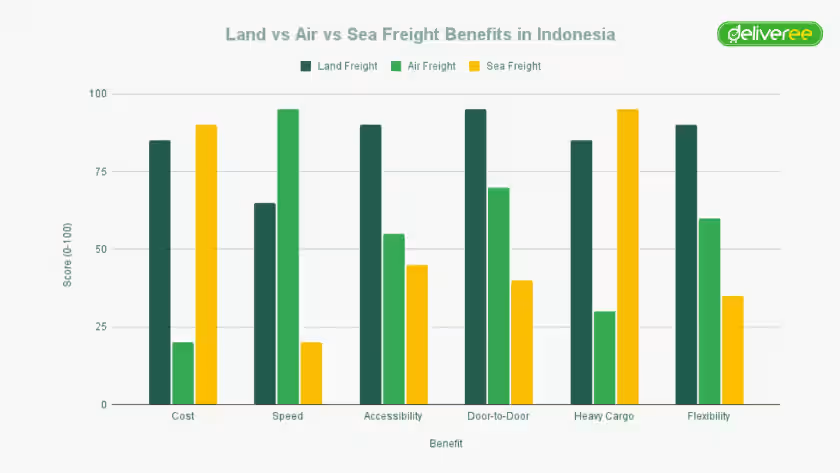
Land freight leads on cost efficiency, door-to-door capability, accessibility, and route flexibility, while air freight’s only advantage is transit speed. Sea freight leads in heavy cargo economics at international scale but loses to land for domestic short-to-medium hauls where truck transit is faster than waiting for vessel schedules. The cost advantage alone is sufficient for most Indonesian businesses to make land shipping their default domestic mode.
Why is Land Cargo Service Cost-Effective for Businesses?
Land cargo service is cost-effective for businesses because it removes terminal handling fees, port surcharges, and airport processing costs that air and sea freight add on top of the base transport rate. Ground vehicles also use cheaper fuel per ton-km than aircraft. Shippers load and unload directly at their own premises, eliminating terminal booking windows entirely. According to the World Bank, air freight is priced up to 5 times higher than road transport per kg, making truck freight the default cost-efficient choice for domestic distribution in Indonesia.
For IndonesianSMEs, the cost difference shows up directly in per-order logistics spend. An SME shipping 300 kg of packaged goods from Bandung to Jakarta by truck pays approximately IDR 400,000 to IDR 700,000 for the full trip. The same shipment by air cargo on a domestic flight would cost 4 to 5 times more before airport terminal fees. The cost gap compounds across hundreds of monthly shipments, making land the only operationally viable mode for most SMEs distributing within Java.
For eCommerce businesses, the ROI case is straightforward. Land shipping enables more frequent, lower-cost restocking cycles, which keeps inventory lean and reduces capital tied up in warehoused stock. An eCommerce seller restocking a Surabaya fulfillment center from a Jakarta warehouse every three days by truck pays approximately IDR 1,500,000 to IDR 2,500,000 per trip, four to five times less than the equivalent air cargo cost before airport terminal fees. Lower per-shipment cost means more shipments per budget, faster stock rotation, and higher gross margin per order.
Decision-makers evaluating land versus air freight should compare three figures, which are cost per kg, terminal handling time, and total landed cost per order. Land freight costs less per kg, clears faster without terminal processing, and carries a lower total landed cost per order for domestic routes within the same island.
Is Land Shipping Suitable for Long-Distance Transport?
Yes, land shipping is suitable for long-distance transport within the same island, and it is the most cost-efficient ground option for intercity routes across Java and Sumatra. Land shipping becomes less suitable when the route requires crossing open water between major islands, where sea freight is cheaper for large volumes and the road network doesn’t physically connect the origin and destination.
Within Java, long-distance land shipping works well. The Jakarta to Surabaya route covers approximately 750 km and takes 12 to 15 hours by truck under normal road conditions. A Double Engkel Long on that route is priced at IDR 5,700,000, which is significantly cheaper than air freight for the same cargo weight. Manufacturing companies, FMCG distributors, and B2B freight operators use this route daily because truck transit is faster than waiting for sea vessel schedules and cheaper than domestic air cargo rates.
Long-distance routes across Sumatra also support direct factory-to-distributor delivery for businesses that need to bypass terminal handling. The road network connecting Medan to Pekanbaru and Palembang supports regular trucking operations, though road quality adds transit time compared to Java routes. The cost per km on Sumatra’s long-distance routes runs 10% to 20% higher than equivalent Java routes due to road infrastructure differences and lower driver availability in certain corridors.
Land shipping is not suitable for routes between Java and Kalimantan, Sulawesi, or Papua because no road bridge connects the islands. The interisland routes require sea or air for the crossing leg. Within any single island, however, long-distance land shipping is viable, cost-effective, and the most direct ground option available.
How to Choose the Best Land Cargo Shipping Service?
Choosing the best land cargo shipping service means evaluating a provider across five decision criteria before committing to a booking or a logistics contract, which are reliability, pricing transparency, geographic coverage, tracking capability, and cargo protection. Most businesses that end up with the wrong provider skipped at least two of these five criteria during the selection process and discovered the gap only after a late delivery or a damaged shipment.
- Check the provider’s reliability record: Reliability shows up in on-time delivery rates, driver accountability, and how the provider handles problems when something goes wrong. Ask for on-time delivery data before signing a contract. A reliable land cargo provider delivers on contracted timelines, uses verified drivers, and responds quickly to issues without making the shipper chase updates.
- Confirm pricing is transparent and quote-based: Pricing transparency means the rate shown before booking is the rate charged at delivery. Avoid providers that quote a base rate and then add fuel surcharges, loading fees, or toll charges after the shipment is complete.
- Verify the service area covers your routes: Coverage determines whether the provider can actually serve a business’s distribution network. A provider with strong Jabodetabek coverage but no intercity routes can’t support shipments from Jakarta to Semarang or Surabaya. Confirm the specific city pairs a business needs before selecting a provider.
- Require real-time GPS tracking as a standard feature: Tracking isn’t optional for B2B logistics. A business shipping IDR 50,000,000 worth of electronics from Bekasi to Yogyakarta needs live shipment visibility, not a phone call to the driver every three hours. Real-time GPS tracking lets the sender and receiver monitor location, verify departure and arrival times, and catch delays before they affect the next step in the supply chain.
- Confirm cargo insurance coverage before the first booking: Cargo insurance protects against financial loss from accidents, theft, and damage during transit. Deliveree Indonesia includes free goods insurance for every booking, underwritten by AXA Indonesia, covering loss and damage without requiring a separate insurance policy. For high-value or fragile goods, confirm whether the provider’s default coverage matches the cargo value or whether supplemental insurance is needed before the shipment moves.
A provider that scores well on all five criteria is worth the contract. The most commonly skipped check is cargo insurance. Businesses that don’t confirm coverage before the first booking discover the gap only after a damaged or missing shipment.
What Features Should You Look for in a Cargo Shipping Service?
A cargo shipping service worth using has four non-negotiable features, which are real-time tracking, cargo insurance, reliable delivery speed, and 24/7 customer support. The four features determine whether a provider gives businesses operational control over their shipments or leaves them guessing every time a truck departs.
- Real-time tracking: Real-time tracking is a GPS-based feature that shows senders and receivers live vehicle location, departure time, current route progress, and estimated arrival window from the moment a driver picks up cargo. Real-time tracking removes the need to call drivers for updates and gives both sender and receiver a shared view of where the shipment is at any point during transit.
- Cargo insurance: Cargo insurance covers goods against loss, theft, or damage during transit and should be automatic on every booking rather than a separate purchase businesses must arrange before each shipment.
- Delivery speed and scheduling flexibility: Delivery speed and scheduling flexibility determine how quickly a provider dispatches a vehicle and whether same-day, future-date, or recurring bookings are supported without manual contract amendments.
- 24/7 customer support. 24/7 customer support availability determines how fast a business gets help when a driver is late, a route needs to change, or a shipment needs rescheduling. A provider with business-hours-only support forces businesses to wait until the next morning to resolve a problem affecting a live delivery. Deliveree’s operations, shipping service, and support lines run 24 hours a day, 7 days a week including weekends and public holidays, so a live agent is always available when something needs to be handled immediately.
A cargo shipping service that covers all four of these features gives businesses operational confidence, not just a booking confirmation. The gap between providers usually shows up not during normal operations, but during the first exception, a delayed driver, a damaged pallet, or a missed delivery window, which is exactly when all four features matter most simultaneously.
Does Tracking Matter in Land Transportation Service?
Yes, tracking matters in land transportation service because it’s the only tool that gives shippers and receivers accurate, live information about cargo location during transit. Without tracking, the only way to locate a shipment on a Jakarta to Surabaya overnight run is to call the driver directly, which is an unreliable method that gives operations managers no verified data and no recourse if the answer is wrong.
A buyer waiting for an IDR 30,000,000 restocking order needs to know whether the truck is two hours away or stuck past midnight. Live tracking answers that without manual coordination. Delivery confirmation uncertainty is one of the most common friction points in Indonesian B2B logistics, and real-time tracking eliminates it by giving both sender and receiver a shared, verified view of shipment progress throughout transit.
When a driver hits a road closure in Semarang or flooding in Central Java, a tracked shipment lets the operations team reroute the vehicle or notify the receiver before the delay becomes a missed deadline. An untracked shipment surfaces the same problem six hours later, after the delivery window has already passed and the downstream production schedule or retail restock has been disrupted.
Tracking creates a time-stamped record of every leg of the trip, from pickup time, route taken, rest stops, to final delivery confirmation. Tracking protects both shipper and carrier if a dispute arises over delivery time, cargo condition at arrival, or route compliance.
What are the Challenges in Land Shipping and Logistics?
The challenges in land shipping and logistics in Indonesia fall into four main categories, which are traffic congestion, regulatory constraints, road infrastructure imbalances, and fuel cost volatility. A truck stuck in Jakarta peak-hour traffic burns more fuel, misses its delivery window, and triggers a cascading delay through the receiver’s inventory schedule, all from a single congestion event.
Traffic congestion is the most immediate challenge Indonesian land shippers face. Urban centers including Jakarta, Surabaya, and Bandung generate traffic conditions that consistently push volume-to-capacity (V/C) ratios above 1.02 during peak hours, according to research using Indonesia’s Road Capacity Guidelines (PKJI). The level of congestion increases freight delivery waiting times by up to 56% on heavily congested corridors, and government measures such as odd-even license plate schemes offer minimal relief for commercial trucks that don’t have flexible schedules. During the 2025 Eid al-Fitr period, land freight deliveries on main Java routes were delayed by up to two full days because private vehicle volumes overwhelmed the road network.
Regulatory constraints create a second layer of disruption. Indonesia’s government issues periodic freight transport restriction orders during national holidays, including joint ministerial decrees that block goods transportation during Eid homecoming and return periods. The 2025 Eid restriction ran from March 27 to April 3 under Joint Decree No. KP-DRJD 1099 of 2025, issued jointly by Indonesia’s Ministry of Transportation, Ministry of Public Works, and National Police, covering land, sea, and port operations simultaneously. Businesses that don’t build these blackout windows into their annual logistics calendar get caught with delayed deliveries and empty warehouses at the worst possible time.
Road infrastructure imbalances create a third challenge, particularly outside Java. Java generates over 60% of Indonesia’s freight and logistics revenue because it has dense toll roads, industrial estates, and high driver availability. Outside Java, road quality and driver density drop sharply. Papua has Indonesia’s second-longest national road network at 2,778 km but a vehicle density of only 93.4 vehicles per km, compared to over 300 vehicles per km in Java and Bali, according to BPS Indonesia’s 2023 transportation statistics. (Flag for verification against the specific BPS dataset before publishing.) That infrastructure gap makes long-haul land shipping in eastern Indonesia slower, less reliable, and more expensive per km than equivalent Java routes.
Fuel cost volatility is the fourth challenge. Fuel makes up 30% to 40% of total trucking operating costs in Indonesia, so any upward adjustment in Pertamina’s pricing directly increases freight rates. More than 60% of trucks on Indonesian roads operate above their legal weight capacity, according to Indonesia’s Ministry of Transportation road safety data, accelerating fuel consumption, increasing vehicle wear, and raising operating costs beyond the base fuel price. Shippers absorb these cost increases through higher freight invoices or renegotiated carrier rates, both of which pressure logistics budgets.
How do Regulations Impact Land Cargo Services?
Regulations impact land cargo services in Indonesia through four operational requirements, which are vehicle permits and licensing, axle weight limits, seasonal freight transport bans, and regional enforcement differences. Each requirement adds compliance cost and scheduling complexity to land logistics operations, and non-compliance carries penalties severe enough to disrupt business continuity.
Every truck operating commercially in Indonesia requires a valid vehicle registration, a road-worthy inspection certificate, and where applicable, a special permit for transporting hazardous materials or oversized cargo. Drivers must hold a Surat Izin Mengemudi license at the appropriate class for their vehicle type. A SIM B2 license is required for operating heavy goods vehicles above five tonnes, while smaller commercial vehicles require a SIM B1. Operating without the correct permits results in fines, vehicle seizure, and potential suspension of the carrier’s operating license.
Axle weight limits are the most actively enforced regulatory requirement in Indonesian land freight, governed by Law No. 22 of 2009 on Road Traffic and Transportation, together with Government Regulation No. 55 of 2012 on Vehicles, which sets the legal framework for maximum permissible weight and maximum combined weight per truck type. Enforcement through Motor Vehicle Weighing Implementation Unit (UPPKB) inspections has identified significant non-compliance. Out of 752,000 vehicles inspected between January and April 2025, 129,887 exceeded load limits, representing a 17.3% violation rate. Carriers must display their JBI and JBKI weight ratings on vehicle documentation for UPPKB inspection.
The government’s Zero ODOL policy (Over Dimension and Over Load) is the most consequential current regulation affecting Indonesian land cargo operations. The Ministry of Transportation is accelerating enforcement, with a full law enforcement trial scheduled for mid-2026 before mandatory compliance takes effect in 2027, according to the Ministry of Transportation’s enforcement timeline as of early 2026. Carriers operating over-dimension and overload trucks face route bans on toll roads and crossing ports including the Tanjung Priok to Cikampek corridor, which is Indonesia’s busiest freight route. Over-dimension and overload violations also expose operators to criminal penalties, including imprisonment for serious cases under Indonesia’s Road Traffic and Transportation Law.
Indonesia’s government issues joint ministerial decrees each year restricting freight vehicle movement during Eid al-Fitr, Eid al-Adha, Christmas, and New Year periods. The 2025 Eid restriction ran from March 27 to April 3 under Joint Decree No. KP-DRJD 1099 of 2025, issued jointly by the Ministry of Transportation, Ministry of Public Works, and the Indonesian National Police, while the 2026 restriction ran from March 13 to March 29 under a corresponding joint decree, confirming that annual blackout windows run 16–17 days each Eid season. Businesses that don’t block out these restriction windows in their logistics calendar face distribution halts that delay supplier payments, drain warehouse stock levels, and strand cargo at collection points.
Regional regulatory differences add a fourth layer of complexity for intercity land freight. In Aceh and North Sumatra, road enforcement data shows that 30% to 40% of trucks on certain corridors carry over 100% excess weight beyond the statutory limit, suggesting enforcement intensity varies significantly between Java and outer island provinces. A carrier that operates compliant vehicles on Java may find different effective rules on Sumatra routes, where weight station coverage is thinner and enforcement practices differ between district and provincial administrations.
Can Delays Affect Land Cargo Shipping Reliability?
Yes. Delays directly affect land cargo shipping reliability by breaking the delivery windows that businesses depend on for inventory management, production scheduling, and customer fulfillment. A single delayed shipment doesn’t affect just one delivery, it shifts the entire downstream logistics sequence that was planned around that arrival time.
Traffic congestion causes the most frequent delays in Indonesian land freight, peak-hour conditions on urban routes push planned four-hour intracity delivery windows into six- to eight-hour actual transit times on the most affected corridors, congestion increases delivery waiting times by up to 56%. A manufacturer waiting for components to arrive by noon to run an afternoon production shift faces a direct output loss when the truck arrives at 5 PM instead.
Vehicle breakdowns add unpredictable delay exposure, particularly for carriers running older trucks that haven’t yet met ODOL compliance requirements. Indonesia’s trucking fleet carries a high proportion of older vehicles, and a carrier running non-compliant trucks risks both breakdowns mid-route and forced detours when UPPKB inspection stations turn the vehicle back, either outcome adds hours to transit time and increases the chance of a missed delivery window.
Regulatory restrictions are the most predictable delay source and the easiest to plan around, since Eid, Christmas, and New Year blackout windows are announced months in advance. The 2025 Eid al-Fitr freight restriction halted land cargo on main Java routes for up to 16 days, pushing distributors into pre-holiday forward purchasing or post-holiday stock shortages depending on how far in advance they adjusted their procurement schedule.
Businesses that use providers with GPS tracking, route optimization, and 24/7 dispatch support absorb delays better than those using untracked carriers. Deliveree’s platform notifies both sender and receiver of trip status in real time, so a delay is visible the moment it happens, not after the missed delivery window has already passed. A tracked delay is a recoverable problem. An undetected one compounds silently across every downstream step, missed production windows, unfulfilled orders, and emergency restocking costs that a single GPS notification could have prevented.







 Chat
Chat